
A/C Condensate Drain Inspection Checklist for Home Buyers
Use the inspection window to understand how the home handles A/C moisture, spot warning signs, and ask better questions before closing.
Start the checklistQuestions to ask
The condensate drain belongs in your home-buying conversation
When an air conditioner cools humid air, water collects at the indoor coil and must travel safely from the equipment to an approved discharge point.
A blocked, damaged, poorly supported, or unidentified drain can contribute to standing water, float-switch shutdowns, ceiling stains, damaged finishes, and repeat service calls. One dry inspection does not prove the drain has always worked perfectly. It does give you a chance to document the visible system, look for a history of moisture, and decide whether a licensed HVAC evaluation belongs in your inspection period.
Ask the inspector to help you identify each visible part rather than assuming every white pipe near the equipment is a condensate drain. The A/C condensate drain parts diagram is a useful companion for learning the names before inspection day.
Collect history before you judge one moment
Request the age and service history of each cooling system, invoices for recent drain or water repairs, and any seller disclosures related to HVAC leaks, ceiling stains, condensate pumps, float-switch trips, or recurring cooling shutdowns. If the home has more than one air handler, make a separate record for every system.
How many systems?
Record which air handler serves each floor or zone and where it is located.
What happened before?
Look for service invoices, repair photos, paint or drywall work, and maintenance records.
What can be seen?
Attic heat, stored belongings, locked rooms, or unsafe platforms may limit the inspection.
If the system cannot be operated because of outdoor temperature, utilities, safety, or seller instructions, note the limitation. A later HVAC inspection may be more useful than treating an untested drain as either good or bad.
Follow the visible drainage story
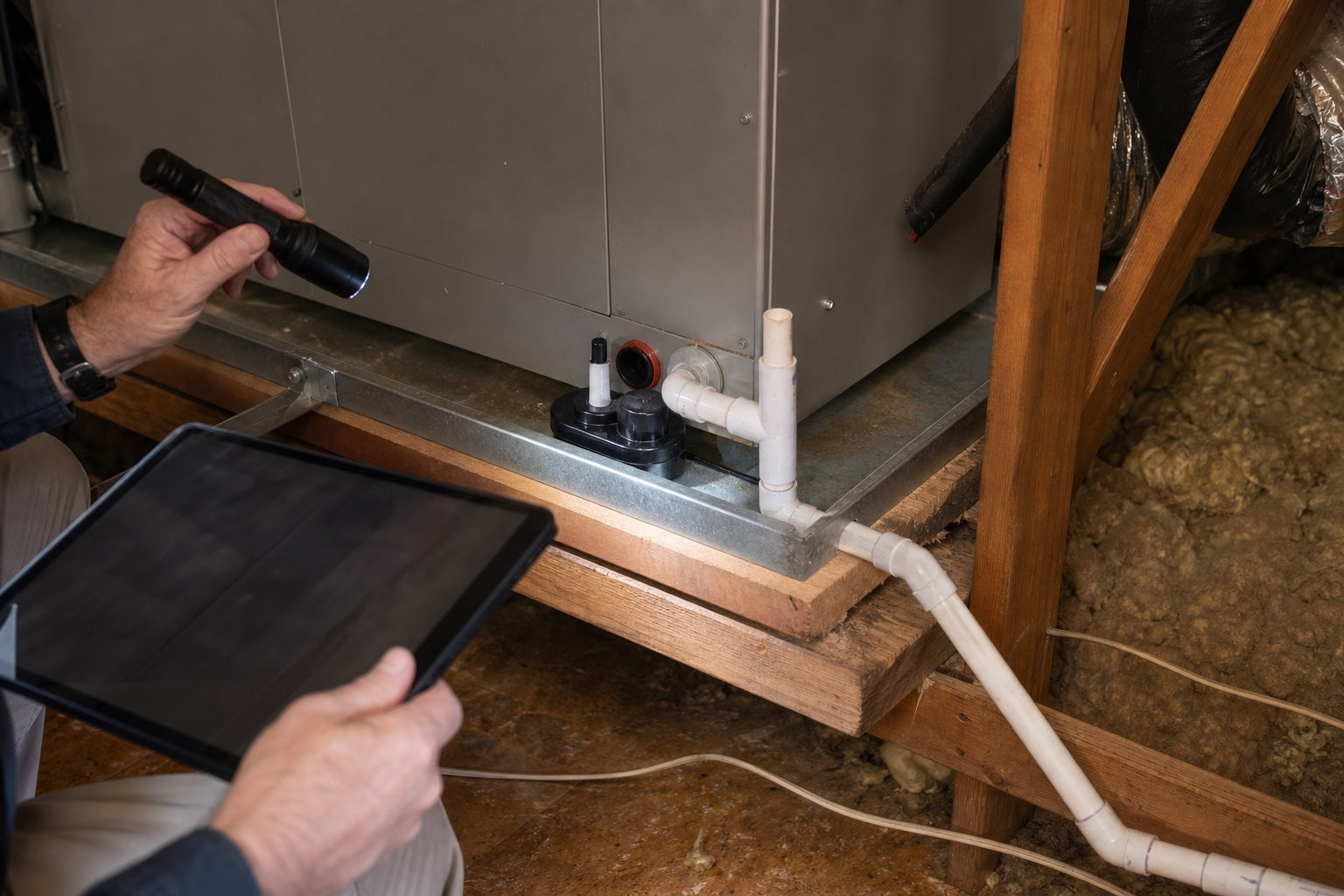
- Find the air handler and surrounding surfaces. Look at the platform, floor, wall, ceiling, insulation, and framing for active moisture, staining, swelling, rust trails, patching, or recently painted areas.
- Identify the primary drain connection. Ask where condensate leaves the equipment and whether an accessible cleanout or service opening is present. Do not remove panels or open a capped pipe yourself.
- Look at the primary and auxiliary pans. Visible standing water, corrosion, cracks, heavy residue, or an improvised repair deserves explanation. A dry pan is useful evidence, but not proof against an intermittent problem.
- Locate overflow protection. Ask about the float switch, secondary drain, auxiliary pan, or other protection serving the installation. Never bypass or test a safety control yourself.
- Trace accessible piping. Note disconnected fittings, cracks, poor support, low spots, or a route that disappears without a clear destination. Installation requirements vary, so let the inspector or HVAC professional interpret the finding.
- Identify a condensate pump if used. Record its location, apparent condition, discharge route, and service history. Pumps introduce another component that can fail or lose power.
- Find the discharge point. Confirm that the inspector can positively identify where the drain terminates. Look for burial by mulch or soil, damage, insect activity, or discharge that may affect finishes or foundations.
- Connect the drain to the home's clues. Ask whether ceiling stains, musty odors, patched drywall, water marks, or prior float-switch events align with the equipment and drain route.
Visual inspection only. Do not enter unsafe attics, touch wiring, open energized equipment, pour chemicals into an unidentified pipe, or rely on a seller's demonstration as a substitute for professional evaluation.
Turn observations into the right next step
| What the report shows | Useful buyer response | Why |
|---|---|---|
| Dry area, identified route, no visible damage | Keep the baseline photos and ask about routine service | Normal visible conditions are worth documenting for future comparison |
| Old stain with no active moisture | Ask when it occurred, what was repaired, and whether records exist | The stain may be historical, but the repair story still matters |
| Standing water, active dripping, or wet building materials | Request prompt professional evaluation and a written repair scope | Active moisture should be understood before it is covered or painted |
| Repeated shutdowns or float-switch trips | Ask an HVAC professional to diagnose the recurring cause | A switch may be doing its job while the underlying drainage issue remains |
| Unknown termination, shared drain, or inaccessible components | Document the limitation and decide whether additional evaluation is needed | Uncertainty is not a diagnosis, but it is relevant to ownership planning |
| Condensate pump with little history | Ask for testing, age, service records, and replacement planning | The drain depends on a powered mechanical component |
Questions worth asking before closing
- Which air handler and drain serve each floor, addition, or zone?
- Has the drain ever clogged, overflowed, leaked, or caused the system to stop?
- What caused any ceiling stain, pan corrosion, drywall repair, or recent paint?
- When was the system last serviced, and was condensate drainage tested?
- Where do the primary and secondary drains terminate?
- Does the installation use a float switch, auxiliary pan, or condensate pump?
- Are there invoices, photos, warranties, or transferable service agreements?
- What condition should be rechecked during the final walkthrough?
Wide and close photos with written limitations
HVAC findings when additional review is needed
Invoice, scope, completion photo, and test result
Final walkthrough baseline and maintenance plan
Keep the original inspection report with any specialist report and repair documentation. Neutral language is most useful: “water observed in auxiliary pan,” “termination not identified,” or “staining below attic air handler.” Avoid changing the finding into a cause unless a qualified professional has confirmed it.
Carry the baseline into maintenance
After closing, label each system in your records and follow the equipment manufacturer's instructions and your HVAC professional's maintenance plan. Save the inspection photos, learn where the thermostat and air handler are, and know what a float-switch alert or secondary-drain discharge looks like.
Use the A/C drain-line maintenance checklist to build a seasonal routine. If the home has multiple cooling systems, the multiple A/C units guide can help you map each drain separately.
For compatible systems, Unclog is designed around automatic condensate-drain maintenance that helps reduce buildup between service visits. Review system compatibility before making a plan. A product cannot correct damaged piping, failed pumps, improper installation, active leaks, or other defects that require professional service.
Home-buyer A/C drain FAQ
Does a standard home inspection test the condensate drain?
Scope varies by location, standards, access, operating conditions, and the inspection agreement. Ask your inspector what was visible, what was operated, what was limited, and when an HVAC evaluation is recommended.
Is a ceiling stain proof that the A/C drain is clogged?
No. A stain can have many causes and may be old. Document the location and moisture condition, then ask the appropriate professional to identify the source.
Should I ask the seller to clean the drain before closing?
Cleaning is not a substitute for diagnosis when there is standing water, damage, repeat shutdowns, or an unidentified drainage path. Use the inspection findings and professional advice to decide what evaluation or repair documentation you need.
Can I test the drain myself during a showing?
No. Do not open equipment, bypass switches, pour liquids or chemicals, or enter unsafe areas. Coordinate testing through the inspector, seller, and a licensed HVAC professional when appropriate.
What should I recheck at the final walkthrough?
Recheck any previously documented moisture, stains, pans, alerts, repairs, and accessible termination points. Confirm that promised documentation has been delivered and ask about any new HVAC change since the inspection.
Understand the drain first. Then build prevention around the real system.
Explore Unclog and confirm compatibility only after the home's condensate layout and any inspection findings are understood.
Explore UnclogCheck compatibility