
Common in apartments and warm-climate homes
Look behind a louvered door or dedicated closet panel. The air handler may stand vertically with a drain pan beneath it.
Start at the indoor air handler, identify the correct PVC connection, and follow the condensate route without opening equipment or guessing which pipe is which.
Get the quick answerFind your air handler
Look near the indoor air handler or furnace, not at the outdoor condenser. A small white PVC pipe commonly leaves the lower part of the evaporator coil cabinet and carries condensation toward a floor drain, plumbing receptor, condensate pump, wall penetration, or outdoor termination.
The metal cabinet can contain moving equipment, sharp edges, high voltage, and wet electrical components. You do not need to remove a panel to locate the visible drain connection. If water is near wiring, the ceiling is sagging, or the equipment area is unsafe to access, stop and call a licensed HVAC professional.
The outdoor condenser does not normally produce the condensate that this drain carries. Moisture forms on the cold indoor evaporator coil. The coil is usually inside or attached to the air handler or furnace, so locating that equipment gives you the beginning of the drain route.
Look behind a louvered door or dedicated closet panel. The air handler may stand vertically with a drain pan beneath it.
The coil may sit above or beside a furnace. Follow the insulated refrigerant lines to the coil cabinet, then look for a smaller PVC drain connection.
Horizontal air handlers often sit in a secondary pan on a service platform. Do not cross unfinished framing or enter a confined area that is not safely accessible.
| What you found | What it tells you | Next place to look |
|---|---|---|
| Large metal cabinet with an insulated copper line | You are probably at the air handler or evaporator coil section | Look around the lower cabinet for one or more small drain ports |
| Only the outdoor fan unit | You found the condenser, not the indoor condensate source | Return inside and locate the air handler or furnace |
| Small pump with a plastic reservoir and vinyl tubing | The system may use a condensate pump when gravity drainage is not practical | Trace the short inlet from the equipment and the separate pump discharge |
| Ceiling cassette or wall-mounted mini-split | The drain may be concealed or pumped through a different route | Use the equipment manual or a qualified mini-split technician |
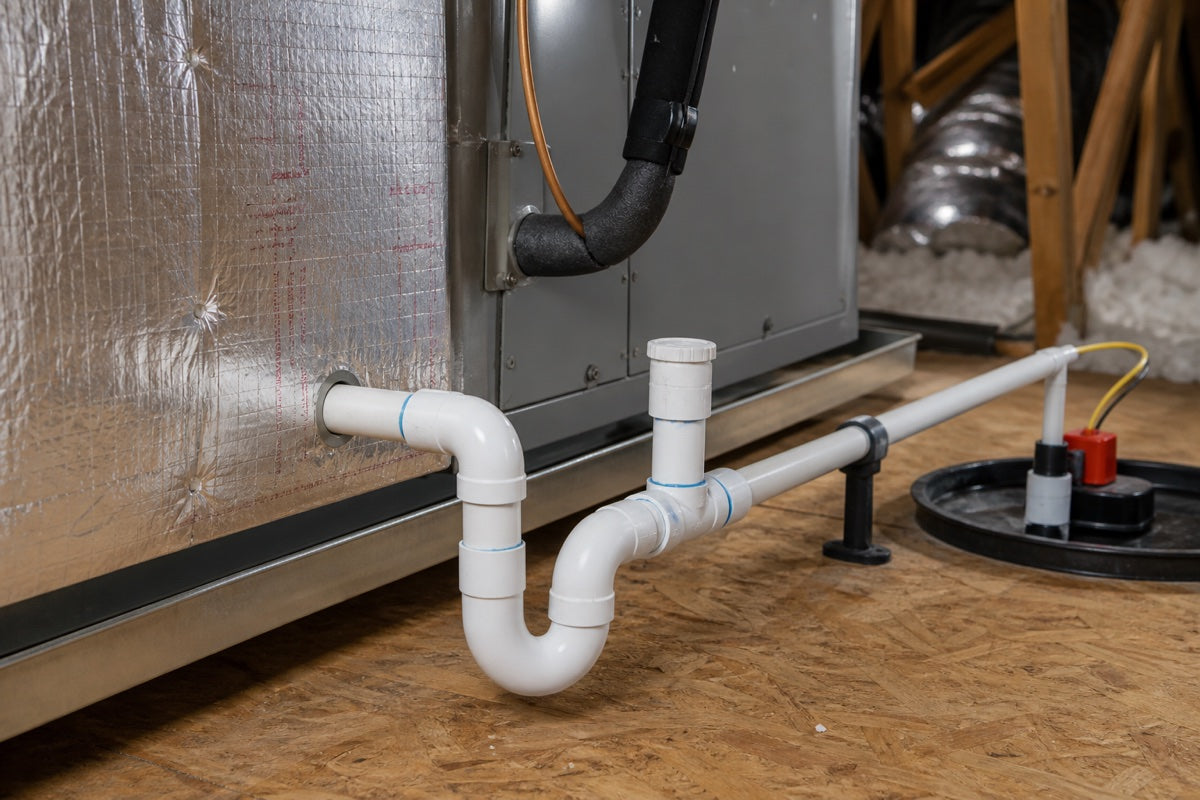
Trace only what is visible and safely accessible. The pipe may disappear through a wall, floor, or ceiling before reappearing outside. A second line can serve as an emergency or secondary drain and may terminate over a window, doorway, or other noticeable location so dripping warns the homeowner of a problem.
It is probably a gravity drain. Continue looking for the wall or floor penetration and then the exterior or approved indoor termination.
The system likely uses a condensate pump. Do not treat the thin pump discharge tube as the same maintenance point as a gravity line.
Do not cut drywall or guess at hidden fittings. Record the entry point and look for plans, service notes, or the matching termination.
That can be a warning that the normal path is restricted, the equipment is leaking, or the primary pan is overflowing. Arrange prompt professional diagnosis.
If you are trying to match the indoor run to its exterior endpoint, use the separate outdoor A/C drain-line location guide. For a component-by-component view, see the condensate drain parts diagram.
Do not pour chemicals into an unidentified fitting, blow compressed air toward the coil, connect a wet vacuum to an indoor vent at random, or bypass a float switch. These actions can damage equipment, push debris the wrong direction, create leaks, or defeat a safety device.
| Condition | Why it matters | Best next step |
|---|---|---|
| Water near wiring, controls, receptacles, or a light fixture | Electrical shock and equipment damage are possible | Keep away, shut cooling off at the thermostat if safe, and call qualified help |
| Sagging ceiling, spreading stain, or active overflow | Materials can fail and moisture damage can grow quickly | Protect the area from occupants and arrange HVAC and water-damage response |
| Attic or crawlspace route is not safely accessible | Falls, heat stress, sharp surfaces, and hidden framing are serious hazards | Do not enter; provide the access location to the service company |
| The system uses a condensate pump | The pump, check valve, reservoir, switch, and discharge need separate diagnosis | Use the condensate pump troubleshooting guide and call a professional when required |
| You cannot distinguish the drain from other piping | Servicing the wrong line can create a leak or equipment problem | Ask a licensed HVAC professional to label the route |
Once a qualified HVAC professional confirms a compatible, open gravity drain and identifies the exterior termination, Unclog can support scheduled suction-based maintenance from outside. It does not replace diagnosis, repair damaged piping, service condensate pumps, or make an unsafe indoor area accessible.
The condensate drain starts at the indoor evaporator coil drain pan. It may then travel through the house and terminate outdoors or at another approved discharge point. The outdoor condenser is not normally the source of this condensate.
Many central systems use a small white PVC pipe connected near the lower part of the evaporator coil cabinet. A trap, capped service point, float switch, secondary pan, or condensate pump may be nearby. Designs vary.
One may be the primary drain and the other a secondary or emergency route. Some systems instead use one drain plus a float switch. A technician can confirm the function of each port and line.
Some systems discharge to an approved floor drain, receptor, plumbing connection, or condensate pump rather than directly outdoors. The installation must follow equipment instructions and applicable codes.
It depends on whether the fitting is a cleanout, a vent, or another part of the pressure-control design. Do not add or remove a cap based on appearance alone. Follow the equipment and installation requirements.
Only use a method approved for the identified system and within your ability. Indoor service can involve wet electrical components, difficult access, and the risk of pushing debris toward the coil. Professional service is appropriate when the route or method is uncertain.
This guide helps identify visible components. It does not replace the equipment manual, local code requirements, or on-site diagnosis by a qualified HVAC professional.
A clearly documented condensate path makes maintenance safer and helps a technician solve problems faster.
Find the outdoor endpointExplore maintenance guides