
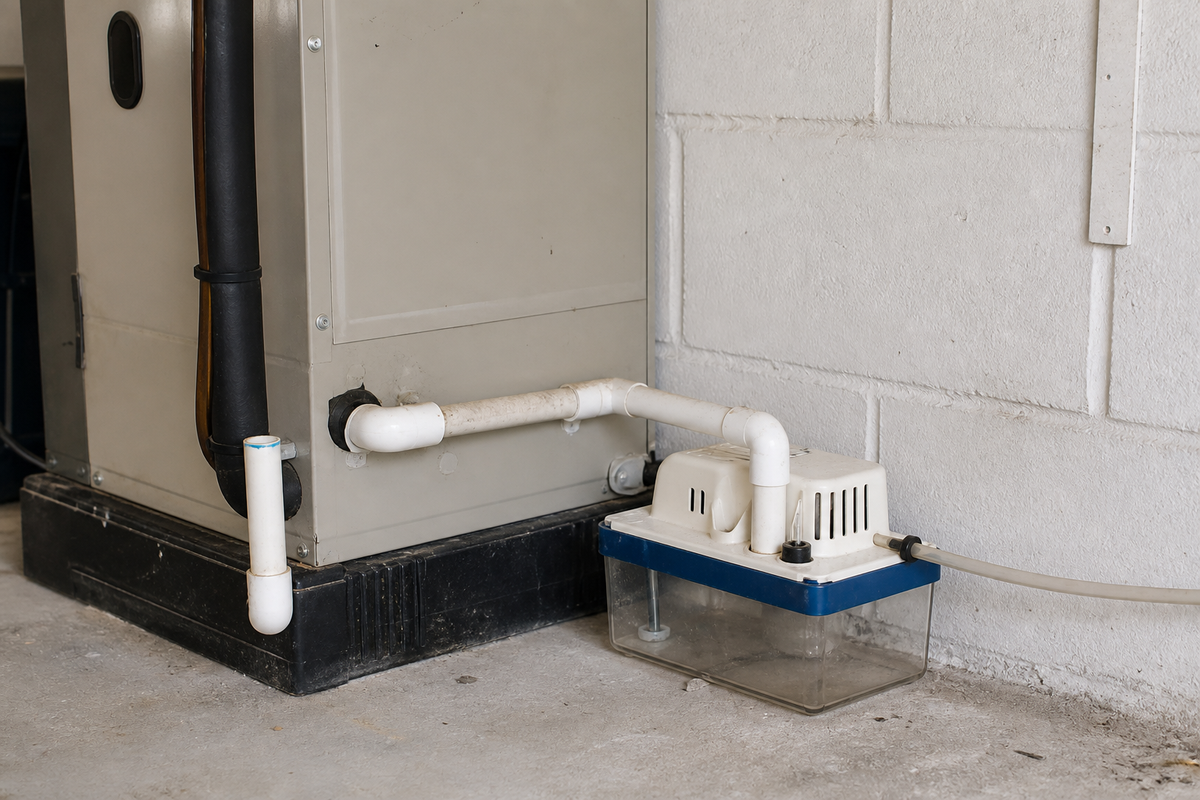
Quick answer: An A/C condensate pump is not working normally when its reservoir stays full, water overflows, the motor hums without moving water, or the air conditioner repeatedly shuts off. Turn cooling off if water is escaping. You can safely check the outlet, plug, visible tubing, and water level, but motor, float-switch, and wiring diagnosis should be left to an HVAC professional.

A small box near an air handler can create a surprisingly large problem. When the condensate pump stops moving water, the A/C may shut down, the reservoir may overflow, or moisture may appear around the equipment. The symptoms can look like a clogged drain line because both problems interrupt the same water-removal path.
The useful question is not simply, “Is the pump bad?” First determine whether water is reaching the pump, whether the pump is trying to run, and whether the discharge path is open. Those observations help separate a pump problem from an upstream drain clog or another source of water.
What an A/C condensate pump does
During cooling, humid air passes over the cold evaporator coil. Water condenses on the coil, falls into the primary drain pan, and enters the condensate drain. Many systems use gravity to carry that water outdoors or to an approved drain. When the equipment sits below the available drain point, a condensate pump lifts the water instead.
The pump collects water in a small reservoir. As the water rises, a float activates the motor. The motor pushes water through a narrow discharge tube. Some installations also connect a safety switch to the A/C controls so the system stops cooling before the reservoir overflows.

A pump that is nearly empty may not be receiving water. A pump that is full has received water but has not removed it. That distinction is the fastest way to decide where to look next.
Signs a condensate pump is not working
These symptoms point toward the pump or its discharge path:
- The reservoir is full or overflowing. Water has reached the pump, but it is not leaving fast enough.
- The pump hums or runs continuously. The motor may be struggling, the outlet tube may be restricted, or the float may be stuck.
- The pump is silent while the reservoir is high. The pump may lack power, or its float, motor, or safety wiring may have failed.
- The A/C shuts off and restarts after the reservoir is emptied. A connected safety circuit may be responding to high water.
- Water appears around the pump rather than the air handler. The reservoir, inlet connection, check valve, or discharge tube may be leaking.

Do not assume every puddle means the pump failed. Water may travel along a pipe or cabinet before it drips. A cracked drain pan, frozen coil, loose fitting, blocked upstream drain, or sweating uninsulated pipe can wet the same area. If you are unsure where the water begins, start with the guide to a full A/C drain pan or the A/C condensate leak hub.
Safe checks you can make before calling
Water and electricity are a bad combination. Do not open the pump housing, touch wiring, bypass a safety switch, or reach into standing water near an outlet. If water is escaping, turn the thermostat to off. If you can do so without entering a wet area, shut off power to the affected equipment at the appropriate disconnect or breaker.
- Look at the reservoir level. Nearly empty points upstream. High water points to the pump or discharge side.
- Confirm the plug is fully seated. Only touch a dry plug and dry receptacle. Do not reset a wet outlet.
- Follow the visible discharge tube. Look for a kink, pinch, loose connection, or crushed section.
- Check the outlet end. Make sure it has not been buried, capped, or blocked by debris. Do not blow into the tube.
- Listen without touching. A hum, repeated clicking, or continuous run helps a technician narrow the failure.
- Note what the thermostat says. If the A/C stopped at the same time the pump filled, a safety switch may have opened the control circuit.

Common reasons a condensate pump stops moving water
Blocked or kinked discharge tubing
The small tube leaving the pump can collect buildup, kink behind equipment, or become blocked at its termination. A running pump cannot move water through a closed path. The motor may run longer than normal while the reservoir stays high.
Stuck or fouled float
Residue in the reservoir can interfere with the float that starts the pump. The float may fail to rise, fail to fall, or move inconsistently. Cleaning procedures vary by pump model, so follow the manufacturer’s instructions or have an HVAC professional service it.
Failed motor or internal switch
Motors and switches wear out. A silent pump with a high reservoir may have power or internal-component trouble. A pump that only hums may have a seized or obstructed mechanism. These are not good homeowner electrical projects.
Upstream drain restriction
If the pump reservoir stays empty while the drain pan fills, condensate may not be reaching the pump. The primary drain could be blocked, improperly pitched, disconnected, or trapped incorrectly. This is where the symptoms overlap with a clogged A/C drain line.
Improper lift or installation
Every pump has limits for how high and how far it can move water. Excessive lift, poor tubing routing, a missing check valve, or an unsuitable pump can cause slow drainage and frequent cycling. Installation requirements depend on the equipment and local code.
Should you clean, repair, or replace the pump?

A visible kink or blocked outlet may be simple to correct. A dirty reservoir may be serviceable if the manufacturer provides a safe cleaning procedure and power can be fully disconnected. Repeated overflow, intermittent operation, a failed motor, heat damage, cracked plastic, or unreliable safety-switch behavior usually justifies professional replacement rather than repeated resets.
Call an HVAC professional promptly when:
- water is near wiring, outlets, ceilings, or finished floors;
- the pump smells hot or burned;
- the breaker or GFCI trips again after the cause is unknown;
- the pump is full but silent;
- the A/C repeatedly stops because the safety circuit opens; or
- you cannot identify whether the water came from the pump, drain pan, coil, or plumbing.
How to reduce the chance of another backup
Include the condensate pump in routine A/C maintenance. Check that the reservoir is clean, the float moves as intended, the discharge tube is secure, and water exits at the proper location. The pump should be tested according to its manufacturer’s instructions. An HVAC technician can also confirm that the safety switch actually stops cooling before an overflow.
The pump cannot compensate for a neglected upstream drain. Keep the coil, pan, filter, and condensate line in the maintenance plan. EPA guidance notes that a plugged condensate drain can contribute to water damage, excess humidity, and biological growth. See our A/C drain maintenance plan for a practical inspection schedule.
If recurring biological buildup is the larger problem, learn how Unclog is designed to provide automatic A/C drain-line maintenance. It addresses the drain line, not a failed pump, damaged pan, frozen coil, or electrical fault.
Frequently asked questions
Why is my condensate pump full of water?
Water is reaching the reservoir but is not being discharged normally. Common possibilities include a blocked or kinked outlet tube, stuck float, failed motor, power problem, or installation that exceeds the pump’s lift capacity.
Will a bad condensate pump stop the A/C?
It can. Many installations connect a high-water safety switch to the A/C control circuit. When the reservoir rises too far, the switch stops cooling to reduce overflow risk.
Can I run the A/C if the condensate pump is broken?
No. Continued cooling produces more water. If the pump cannot remove it, the reservoir or drain pan can overflow. Turn cooling off until drainage is restored.
How long does an A/C condensate pump last?
There is no reliable universal lifespan. Run time, water quality, buildup, installation, maintenance, and pump design all matter. Replace a pump based on condition and reliable operation rather than age alone.
Is a condensate pump the same as an A/C drain-line cleaner?
No. The pump lifts collected water to a drain. A drain-line maintenance device addresses buildup within the condensate line. A working system may use both, depending on its drainage layout.
Educational information only. A/C drainage layouts, pump models, wiring, safety switches, and code requirements vary. When water or electrical components are involved, use a qualified HVAC professional.