
Water and immediate hazard
Active ceiling flow, sagging drywall, water near electrical equipment, a rapidly spreading leak, or an unsafe living area deserves emergency escalation under site policy.
Turn a vague “A/C is leaking” report into a safer priority, a clearer dispatch, and a record your maintenance and HVAC teams can actually use.
Classify the callBuild the work order
“Water from the A/C” can mean a small controlled drip, a full auxiliary pan, a frozen coil thawing, a failed pump, a loose connection, or a condensate line restriction.
The first work-order decision is not which repair to make. It is how quickly someone needs to respond and what the resident should do while help is on the way. Property policies, lease terms, staffing, equipment, and local requirements vary, so adapt this framework to the approved emergency plan for the building.
Active ceiling flow, sagging drywall, water near electrical equipment, a rapidly spreading leak, or an unsafe living area deserves emergency escalation under site policy.
A bucket is catching a steady drip, the auxiliary pan is filling, the float switch has stopped cooling, or moisture is affecting finishes without an immediate electrical hazard.
An old stain, occasional musty odor, dry secondary outlet, or historic shutdown can be scheduled when no active water or safety concern is present.
Good intake notes separate location, timing, volume, system behavior, and immediate hazards. They also reduce the chance that a technician arrives with the wrong tools or cannot reproduce the symptom.
Do not promise a cause during intake. A condensate drain problem is common, but roof leaks, plumbing, frozen coils, damaged pans, pumps, and other sources can look similar.
| Field | What to record | Why it helps |
|---|---|---|
| Unit and system | Building, unit, room, thermostat zone, and air-handler location | Prevents confusion on properties with multiple systems or shared chases |
| Observed condition | Active drip, standing water, stain, odor, shutdown, or secondary-drain flow | Keeps the work order based on evidence rather than a guessed diagnosis |
| Start and change | When noticed, whether it is worsening, and what was happening at the time | Helps separate intermittent drainage from a continuous source |
| Immediate action | Containment, resident relocation, system status, supervisor notice, or emergency vendor call | Creates continuity between intake and arrival |
| History | Previous calls, repair dates, contractor notes, and nearby units affected | Repeat or stacked-unit patterns may change the investigation |
| Access | Permission, pets, keys, ceiling access, attic conditions, parking, and resident availability | Reduces failed visits and unsafe improvisation |
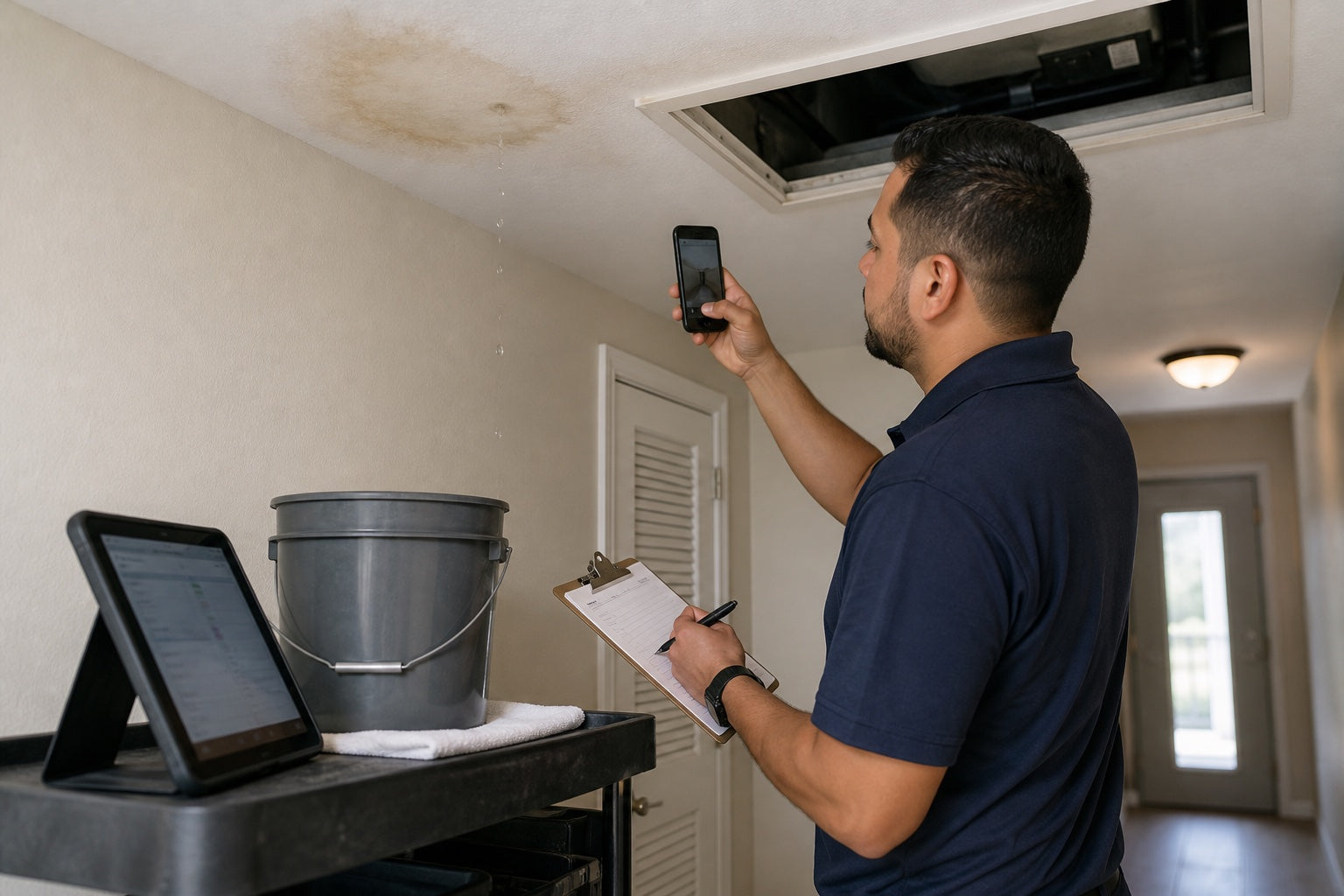
Attach the resident's photos when policy allows, then request new arrival photos from the technician. Label images with the unit and date inside the work-order system rather than placing private resident details in filenames.
Qualified staff should begin by confirming the reported location and checking for active hazards. The next objective is to identify the actual moisture source and the system it belongs to. Opening energized equipment, accessing unsafe ceilings, or performing work outside the technician's training should be handed to the appropriate licensed professional.
A restriction is more likely when water is backing up upstream and the identified downstream path is not carrying condensate normally. It is not the only possibility. A frozen coil, failed condensate pump, cracked pan, disconnected fitting, poor slope, blocked shared drain, roof leak, or plumbing source can require a different repair.
For a homeowner-oriented explanation of restrictions, use the clogged A/C drain-line guide. For a component refresher, see the condensate drain parts diagram.
A useful closeout explains what was found, what action was taken, what test was performed, what remained outside scope, and what follow-up is scheduled. The record should let another technician understand the event without calling the resident again.
When the drain was involved, note the air handler, service point, complete route that was evaluated, material removed if relevant, and where test water or operating condensate discharged. “Vacuumed line” does not prove that every fitting is secure or that water reaches the intended destination without leaking.
Keep moisture remediation and finish repair visible as separate tasks when needed. Closing the HVAC portion should not hide an open drywall, insulation, flooring, or indoor-air-quality concern.
One work order solves one resident's problem. A tagged history can reveal which buildings, equipment types, drain routes, condensate pumps, or seasons are producing repeat calls.
| Pattern | Portfolio question | Possible next step |
|---|---|---|
| Same unit repeats | Was the full drainage path and installation evaluated? | Escalate beyond another quick clearing |
| Several units in one stack | Is there shared piping or a common building condition? | Map the route and coordinate a broader inspection |
| Calls follow peak humidity | Is seasonal preventive work happening before demand? | Move inspections and drain service earlier |
| Pump-served units dominate | Are pump age, power, reservoir condition, and discharge routing recorded? | Create a pump-specific inspection task |
| Float-switch shutdowns repeat | Is the protective device revealing an unresolved drainage issue? | Track cause and verified correction, not only reset events |
For properties with several independent residential systems, use the multiple A/C units planning guide to map each drain separately. After a qualified professional confirms that a compatible gravity drain is correctly installed, open, and suitable, Unclog can support scheduled suction-based maintenance at the drain termination. It does not replace active-leak diagnosis, pump service, damaged piping repair, or required professional maintenance.
Contractors and property teams evaluating a broader program can also review the Unclog Pro pathway.
No. Priority depends on active water, rate of change, electrical exposure, ceiling condition, habitability, and property policy. A dry historic stain is different from water spreading near a light fixture or sagging ceiling.
Follow the property's approved emergency instructions. When active water is associated with the A/C, stopping cooling at the thermostat may limit additional condensate, but residents should not approach wet electrical equipment, open panels, or operate unsafe controls.
It means water has reached the switch's activation point. A restriction is one possibility, but a failed pump, drainage defect, frozen coil, or other moisture source can create a similar condition.
Capture a wide view of the room and equipment location, then close views of active water, stains, pans, switches, accessible piping, temporary containment, completed work, and the final test. Follow privacy and resident-photo policies.
Escalate when water is near electrical components, the source is uncertain, the system or drain is inaccessible, the coil is frozen, a pump fails, a restriction returns, piping is damaged, or the required work exceeds staff training, licensing, or site procedure.
Map each unit, document the drain route, and involve an HVAC professional before adding any preventive device to a property standard.
Plan multiple systemsTalk with Unclog Pro