
A/C Drain Line Maintenance for Vacation Rentals
Build a repeatable condensate-drain routine that protects guest stays, gives cleaners clear inspection boundaries, and helps local service partners find the right system fast.

A small drain problem can become a guest-stay problem
A condensate drain is easy to overlook because it normally works in the background. In a short-term rental, the first obvious warning may arrive as a guest message: the A/C stopped, a ceiling spot appeared, or water is collecting near the indoor equipment.
Heavy cooling demand, humid weather, back-to-back bookings, and remote ownership can compress the time between “something looks off” and an urgent service call. A clogged drain is not the only possible cause of a leak or shutdown, but it is one failure path hosts can organize around.
Protect the stay
Make reporting simple and keep guests away from equipment, panels, chemicals, and wet electrical areas.
Give vendors context
Record which air handler, drain outlet, pump, and float switch belong together.
Prevent repeats
Track the corrective action and adjust the property’s future maintenance cadence.
Start with a one-page system map
A host cannot manage what the team cannot identify. Give each cooling system a permanent ID such as A/C-1, A/C-2, and A/C-3. Use the same ID in your property notes, on the air-handler service label, and beside the confirmed outdoor drain termination when appropriate.
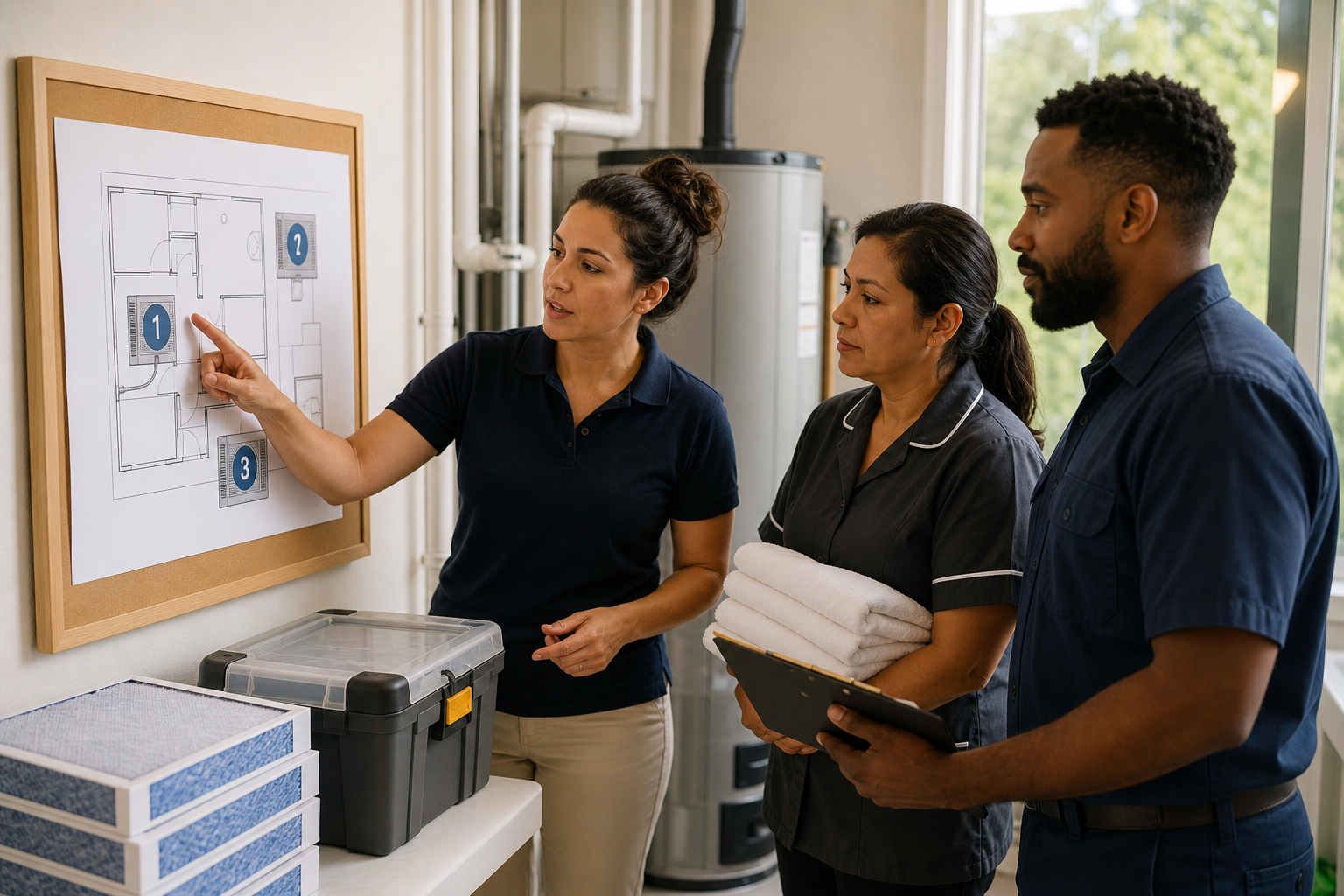
- Indoor-unit location and safe access instructions
- Matching outdoor condensate outlet or approved discharge point
- Whether the system uses gravity drainage or a condensate pump
- Primary and auxiliary pan locations, if visible without opening equipment
- Float-switch location and what a trip looks like
- Preferred HVAC company, after-hours contact, and property access process
If you are not certain which outlet belongs to which system, ask your HVAC contractor to trace and label it. Do not infer the connection from proximity alone. The condensate drain parts and diagram guide can help your team learn the terminology before the service visit.
Use turnover checks for observation, not HVAC service
A cleaner or local caretaker is already in the home between stays. That makes turnover a useful time for a brief visual check, provided the checklist stays within safe limits.
| Turnover observation | Normal response | Escalate when |
|---|---|---|
| Thermostat and indoor comfort | Record the setpoint and whether the home is reaching it. | The system is not cooling, repeatedly stops, or shows an unfamiliar alert. |
| Visible area around the indoor unit | Look from a safe standing position for unexpected water or staining. | Water is active, rising, near wiring, or affecting a ceiling. |
| Known outdoor condensate outlet | Photograph the outlet while the system is running when flow is expected. | The outlet is damaged, obstructed, or shows a major change from the property baseline. |
| Guest-ready documentation | Upload dated photos and short notes to the property record. | The same symptom returns after prior service. |
Build the cadence around the property, not a generic calendar
There is no universal drain-cleaning interval for every rental. Runtime, humidity, occupancy, line length, slope, system age, surrounding debris, and service history all matter. Start with the HVAC manufacturer’s guidance and your contractor’s recommendation, then make the record more specific as the property produces evidence.
| Cadence | Owner or manager action | Purpose |
|---|---|---|
| Each turnover | Complete the safe observations above and capture exceptions. | Catch a visible change before the next arrival. |
| Monthly in peak season | Review outlet photos, service notes, float-switch events, and recurring guest comments. | Spot a trend across bookings rather than treating each message separately. |
| Seasonally | Confirm the drain path, access, labels, and vegetation clearance with the maintenance lead. | Keep documentation aligned with the actual system. |
| Professional service | Have the system and condensate components inspected at the interval recommended for the equipment and local conditions. | Address installation, pump, pan, slope, and mechanical issues beyond a visual checklist. |
For a broader homeowner-level schedule, use the A/C drain-line maintenance checklist. Adapt it to the rental rather than copying every task into a cleaner’s turnover duties.
Know when the drain is only one possibility
Water near an air handler may come from a blocked drain, but it can also involve a cracked pan, loose fitting, frozen coil, failed pump, improper slope, roof or plumbing leak, or another source. A system that will not cool can have electrical, refrigerant, airflow, thermostat, or control problems unrelated to the drain.
- Call promptly for active or spreading water, a full auxiliary pan, or repeated float-switch trips.
- Treat burning odors, electrical symptoms, and wet wiring as urgent safety concerns.
- Have recurring clogs investigated for installation or drainage-path problems, not just cleared again.
- After service, record what was found, which system was affected, and how normal operation was verified.
Use the clogged A/C drain-line guide for symptom context and the A/C stopped or not cooling guide when the symptom is broader than drainage.
Where recurring suction can fit
Once a compatible drain is open, correctly installed, and flowing, Unclog can connect at the end of the condensate drain line and run scheduled suction cycles. For a remote host, that creates a repeatable maintenance action that does not rely on a guest remembering a treatment step.
It does not replace HVAC inspection, repair damaged piping, correct poor slope, or diagnose a pump or float-switch problem. Compatibility and installation location still matter. Review the Unclog compatibility guide or involve your HVAC professional before standardizing a device across several rentals.
Make drain care part of the property system
Unclog uses scheduled suction to help move developing buildup from compatible A/C condensate drain lines. Multi-pack options can support owners managing more than one cooling system or property.
Questions from vacation-rental hosts
Should guests pour vinegar into the A/C drain?
That should not be a standard guest task. The correct access point, product compatibility, amount, and safety conditions vary. Keep HVAC maintenance with the owner, caretaker, or qualified service provider.
Can a cleaner check the drain line at turnover?
A cleaner can perform a clearly defined visual observation from a safe location and report changes. Do not assign panel removal, chemical handling, clog clearing, or work near wet electrical components without appropriate training.
Can a clogged condensate drain shut off the A/C?
Yes, a float switch may interrupt cooling when water rises. That shutdown is protective. Do not bypass the switch. Drainage is only one possible cause of a system that will not run.
How often should a rental’s A/C drain line be maintained?
Use the equipment manufacturer’s guidance and a qualified contractor’s recommendation. Adjust the cadence for climate, runtime, system configuration, and the property’s documented history.
Is Unclog a replacement for professional HVAC maintenance?
No. It is a recurring suction-based drain-line maintenance tool for compatible installations. It does not replace inspection, diagnosis, repairs, or required professional service.
Educational information only. HVAC layouts, manufacturer instructions, leases, platform policies, building requirements, and local codes vary. Use qualified professionals where appropriate.