

Cover: AI-generated editorial collage, not an infestation photo or installation evidence.
A bug near the outdoor A/C drain is a clue, not a diagnosis. The useful question is whether insects or nesting material are obstructing the confirmed condensate outlet—and whether the proposed guard preserves drainage and service access. Unclog addresses a different maintenance need: scheduled suction to help remove developing buildup from a compatible, normally flowing drain.
UNCLOG / OUTLET MAINTENANCE
Keep the outlet useful for more than inspection.
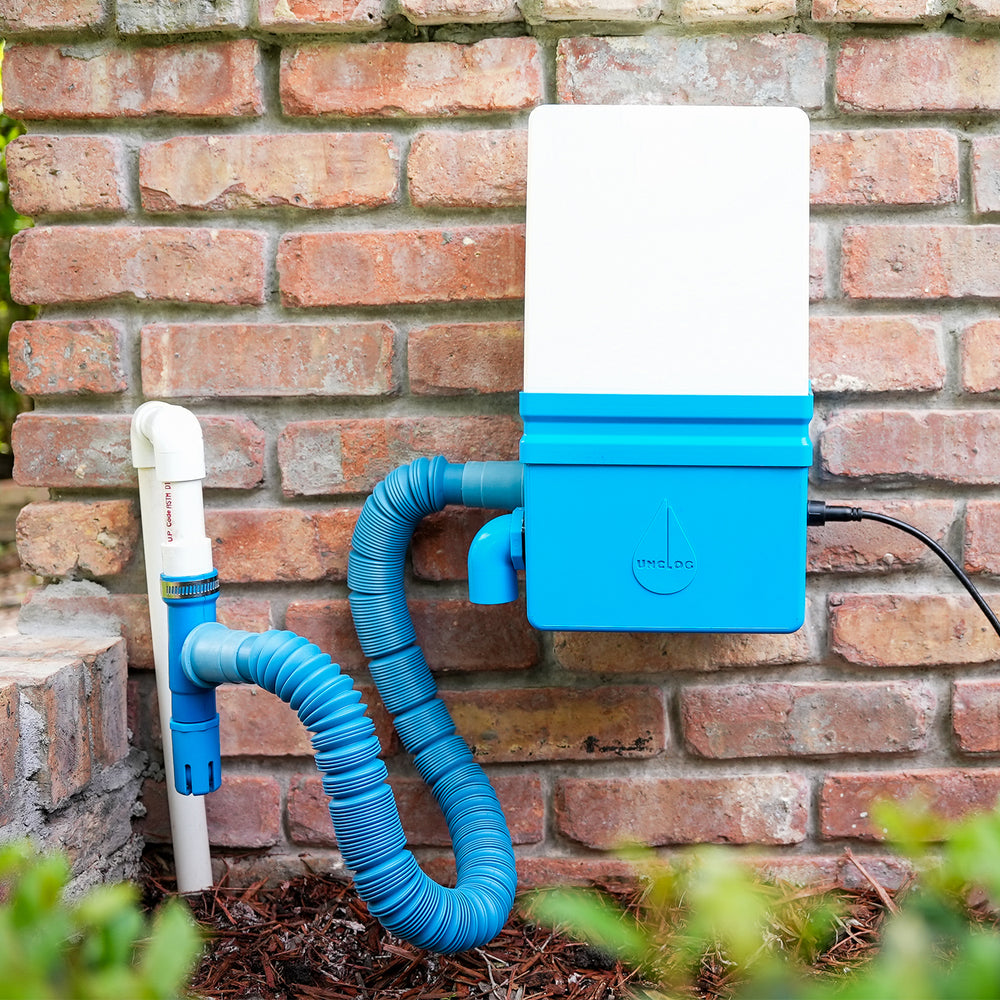
Once the route is clear and normal flow is verified, Unclog uses suction at a compatible outdoor termination to help remove developing buildup without recurring chemical dosing. App scheduling or offline presets make that routine repeatable.
Before adding a screen, cap or adapter, review the actual installation requirements. Do not stack accessories onto Unclog or modify its free-flow arrangement without confirmed compatibility.
Bugs at an A/C drain outlet: what you can actually conclude
Seeing a wasp beside a pipe does not establish a nest inside it. A dry opening does not prove an insect blockage either: cooling runtime, humidity and the discharge destination all affect what you see. First use the outside A/C drain guide to distinguish the normal primary route from an auxiliary or warning outlet.
Purpose-built insect guards are sold specifically for condensate terminations. For example, PVC Vent Screens describes its SVC-IS075 as guarding condensate discharge lines against bee and wasp nests. That establishes the intended application of that particular product; it does not tell you what is blocking your line or how common insect blockages are in your area.
Photograph the visible opening from a safe distance. Record whether material appears across it, whether water is leaking indoors, and whether the change followed landscaping or exterior work. Do not insert wire, push nesting material farther into the pipe or reach toward an active nest. A pest professional can address the insect hazard; an HVAC provider can assess drainage and equipment.
If water is spreading indoors, a pan contains abnormal water or a float switch has stopped cooling, turn cooling off from a safe location and arrange service. Keep away from wet electrical equipment and do not bypass the switch. An outdoor pest investigation should not delay protecting the building.
Screen, solid cap or makeshift mesh? Compare the function
“Cap” is an ambiguous shopping term. Some products are screened guards with open passages; a solid end cap closes the opening. Judge the actual water path rather than the name. Never seal a condensate discharge or warning outlet as a pest remedy.
| Option | Intended function | Check before use |
|---|---|---|
| Purpose-built screened guard | Exclude specified pests while leaving an open passage. | Exact application, pipe fit, drainage, removal and inspection instructions. |
| Solid cap or plug | Close a pipe opening. | Not a pest solution for an operating discharge or warning outlet. |
| Improvised cloth or mesh | Attempt to cover the opening. | No verified fit, retention or drainage performance for the arrangement. |
| Unclog | Maintain a compatible drain with scheduled suction. | Normal flow, mounting, power and the complete compatibility/installation requirements. |
The SVC-IS075 manufacturer specifies a fit over straight 3/4-inch PVC with a 1.050-inch outside diameter and lists a removable set-screw option. Those are model-specific facts, not a recommendation for every A/C system. A nominal pipe size alone does not establish fit with fittings, tubing or another accessory. The pipe-size chart explains nominal versus measured dimensions.
A manufacturer’s mesh specifications are not proof that a screen cannot clog or that it is approved for your installation. Ask the installer how normal discharge will be checked with the proposed guard in place. Do not infer compatibility with Unclog from matching pipe diameters.
The overlooked requirement: can the outlet still be serviced?
A guard that cannot be inspected easily creates a maintenance question. Before installation, ask who will check it, how it is removed, and how a technician will reach the original service point. Follow the accessory’s instructions and equipment requirements rather than copying a generic online method.
Keep the outlet visible to landscapers. Loose leaves and mulch around it are different from material lodged inside the line. Do not bury, paint over or pull on fittings. If the route disappears below ground, use the buried-drain decision guide before assuming that exposing the last visible pipe will resolve the problem.
Pest exclusion and drain maintenance need separate plans
An outlet guard addresses entry at the opening. It does not establish that internal buildup has been removed, that a trap is correct or that the whole route drains normally. If a blockage keeps returning, request a cause-based assessment rather than adding another accessory after each clearing.
After diagnosis, correction of active faults and verified normal flow, Unclog offers a physical suction routine at a compatible outdoor termination. That can reduce reliance on repeated manual cleaning or chemical dosing as the chosen preventive routine. It does not repair frozen coils, pumps, pans, bad piping or active leaks, and it is not an emergency substitute for clearing a blocked line.
Your next step is to document the outlet’s identity and condition, resolve the pest or drainage problem, then review installation guidance and Unclog compatibility. Keep the inspection and service plan alongside any automatic routine.
Common questions about bugs and A/C drain screens
Can insects block an A/C drain outlet?
They can create an outlet concern, and manufacturers sell guards intended to prevent bee and wasp nesting in condensate terminations. A bug near the pipe does not prove that insects caused your particular blockage.
Should I cap the outside A/C drain to keep bugs out?
Do not close a working condensate discharge or warning outlet. A screened guard is different from a solid cap and requires application, fit, drainage and service-access checks.
Can I put a screen on Unclog?
Do not assume a screen or adapter is compatible or alter the free-flow arrangement. Review the actual Unclog and accessory installation requirements and obtain a compatibility answer before combining them.
Will an insect screen stop internal drain slime?
A screen at the outlet does not remove buildup inside the line. Internal maintenance, outlet inspection and correction of drainage faults remain separate tasks.
Source and scope: Reviewed October 3, 2026. PVC Vent Screens SVC-IS075 specifications support the narrow manufacturer example above. This is editorial planning guidance, not a product test, infestation finding or approval of an installation. We make no claim that Unclog prevents insects.