
The quick compatibility answer
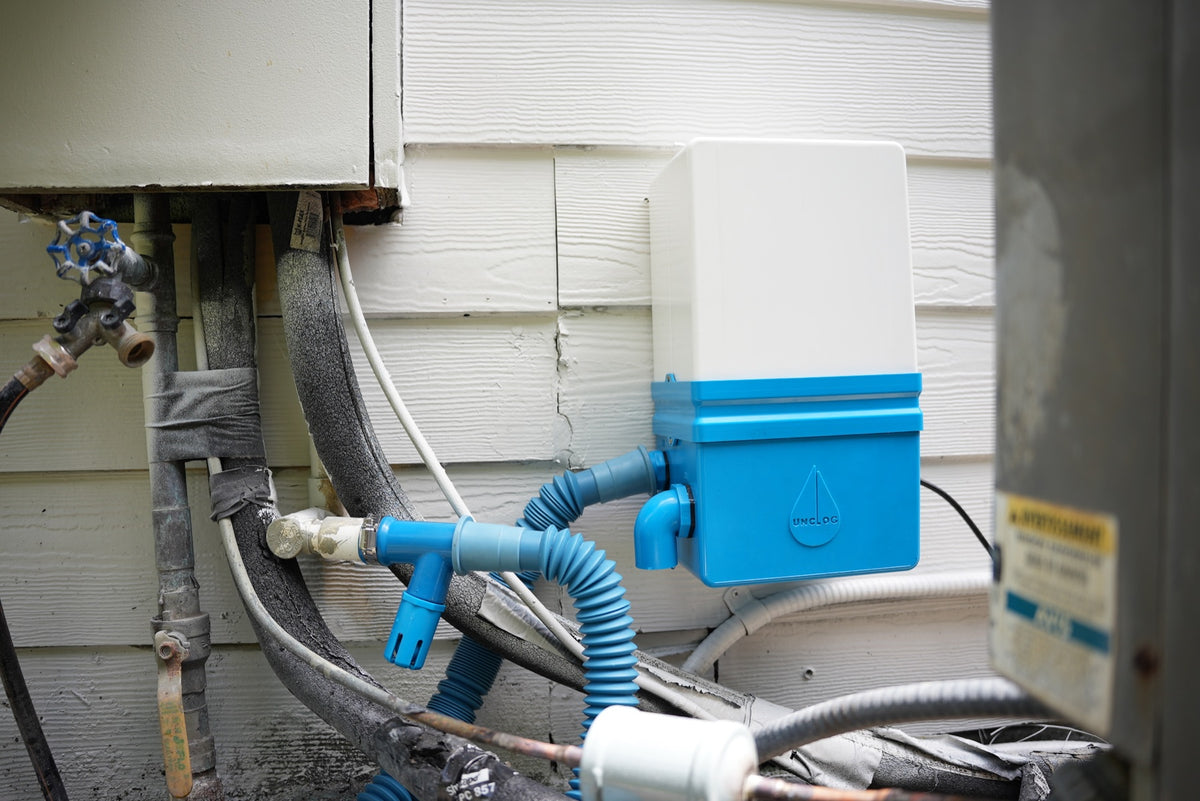
A likely fit has a standard residential condensate line that drains to an accessible outdoor termination, plus a suitable place to mount the production Unclog unit below the primary drain pan or air handler. The installation guide supports 1-inch, 3/4-inch, and 1/2-inch drain lines through the supplied free-flow drain mechanism.
Compatibility is not a diagnosis. A dry outlet does not prove that the line is clogged, and standing water does not prove the pipe is the only problem. A frozen coil, cracked pan, failed pump, disconnected fitting, or poor pipe pitch can create similar symptoms.
Six conditions to confirm before installation
| Condition | What to confirm | Why it matters |
|---|---|---|
| Correct drain outlet | The outdoor pipe is positively traced to the intended A/C condensate system. | Nearby pipes may be plumbing, pool, water-heater, or secondary drains. |
| Supported size | The termination is 1 inch, 3/4 inch, or 1/2 inch as described in the installation guide. | The free-flow mechanism must be prepared for the actual pipe diameter. |
| Normal water path | The line, trap, pump, pan, and fittings are intact and able to drain after any active problem is corrected. | Preventative cleaning should not conceal a failed component or damaged installation. |
| Safe mounting area | A solid surface is available below the primary pan or air handler and close enough to the drain for the supplied hose arrangement. | Location and elevation help the system operate as intended. |
| Correct drain direction | The free-flow mechanism can be oriented for an upward, downward, or sideways outlet according to the manual. | The internal ball mechanism must be positioned correctly to permit drainage and help prevent backflow. |
| Power access | A suitable 110V outlet is available and the cord can be routed safely. | The unit requires power. Wi-Fi is optional, but electricity is not. |
Which A/C drain line sizes are supported?
The current installation guide shows three common condensate outlet sizes. Measure the outside of the actual drain termination or have an A/C professional identify it. Do not choose a fitting by guessing from a photo.
Need to translate an outside measurement into a nominal PVC size? Use the PVC measurement chart and record before completing the compatibility review.
Use the supplied free-flow fitting as described in the guide.
The guide directs the installer to remove the 1-inch section before connection.
The guide directs the installer to remove the 1-inch section and use the appropriate coupler or elbow arrangement.
Pipe diameter alone does not make a system compatible. The termination also needs enough straight, accessible space for a secure connection, the hose clamps must seat properly, and the free-flow mechanism must match the direction in which the drain exits.
Mounting, hose reach, power, and Wi-Fi
Do not mount the unit to a weak surface, block service access, pinch the collapsible hose, or route cords where landscaping equipment can damage them. A crowded mechanical area can still work, but it needs a deliberate layout.
Situations that deserve a closer review

Condensate pumps
A pump changes how water leaves the equipment. Confirm where the pump discharges, whether the outdoor outlet is the correct line, and whether the proposed connection could interfere with pump operation. Ask an A/C professional or Unclog support when the route is unclear.
Shared drain lines
One visible outlet may receive water from more than one system. Map every connection before assuming that one device covers multiple air handlers. Shared drains can also make diagnosis and scheduling more complicated.
Multiple A/C systems
Count condensate routes, not thermostats or outdoor condensers. A home with two systems may have two separate outlets, a pump on one system, or a shared section. Use the multi-system planning guide before choosing coverage.
Active clogs and overflows
Protect the home first. Turn cooling off if water is spreading or touching electrical components. Correct broken pans, failed pumps, damaged pipe, poor pitch, or other installation defects before relying on a preventative schedule.
Unknown or inaccessible outlets
Do not attach equipment to a pipe that has not been positively identified. If the line ends in a wall, attic, plumbing stack, or inaccessible area, a technician can trace the route and recommend a serviceable solution.
Commercial or unusual equipment
The standard homeowner installation is designed around compatible residential condensate drains. Rooftop units, large commercial systems, unusual voltage, or service-team deployments belong in a professional compatibility conversation.
A two-minute pre-install checklist
Dedicated, gravity-fed, and positively identified.
Supported size, orientation, hose reach, and mounting space.
Safe 110V power and optional Wi-Fi within range.
No bypassed float, emergency drain, pump, or shared route.
Confirm all eight before you proceed
- I can identify which air handler feeds this condensate outlet.
- The drain line is 1 inch, 3/4 inch, or 1/2 inch.
- The pipe and fittings are intact and serviceable.
- The free-flow mechanism can match the outlet direction.
- A solid mounting area exists below the primary pan or air handler.
- The mounting point is within the installation range described in the guide.
- A suitable 110V outlet is available.
- Any pump, shared line, or unusual layout has been reviewed.
If one answer is “I do not know,” stop there. A photo of the outdoor outlet, the air-handler label, and the surrounding mounting area can make a support conversation much more useful.
Still not sure whether your system is compatible?
Review the current installation instructions, send clear photos to Unclog support, or ask an A/C professional to trace the condensate route. Once the layout is confirmed, you can decide whether a single system, multi-system plan, or professional installation path makes sense.
View installation instructions Contact Unclog support See how Unclog worksThe route, size, orientation, mounting space, power, drainage, and safeguards are all confirmed.
The outlet is unknown, pumped, shared, damaged, inaccessible, actively backed up, or outside the instructions.
Compatibility FAQ
Does Unclog fit a 3/4-inch A/C drain line?
Yes. The current installation guide includes preparation instructions for a 3/4-inch drain termination. The rest of the layout still needs to meet the mounting, orientation, drainage, and power requirements.
Does Unclog fit a 1/2-inch drain line?
The guide includes a 1/2-inch configuration using the appropriate coupler or elbow arrangement after preparing the supplied free-flow mechanism. Verify the actual pipe size and available connection space before installation.
Is Wi-Fi required?
No. The guide provides offline preset schedules in addition to app-based online setup. A 110V power source is still required.
Can one Unclog serve two A/C units?
Do not assume so. Trace each condensate route. Separate drain lines generally need separate planning, while a shared line should be reviewed because one outlet may not tell the full system story.
Will Unclog fix a leaking drain pan or failed condensate pump?
No. Those are equipment or drainage-system failures that need diagnosis and repair. Unclog is not a substitute for a sound pan, working pump, correct pipe pitch, secure fittings, or functioning safety controls.
Can I install it if I cannot find the outdoor drain outlet?
No. Positively identify the condensate termination first. Guessing can lead to connecting to the wrong pipe or missing a problem elsewhere in the route.
Return to the A/C Drain Care Learning Center or continue with the A/C drain-line maintenance guide.