
A/C DRAIN CARE · CLEANER COMPATIBILITY
A backed-up A/C drain can make the bottle under the sink look like a quick fix. But before you pour Drano into an A/C condensate line, check the application, not just the pipe material. This guide explains the label question, what changes if cleaner is already in the line, and how Unclog uses scheduled suction for ongoing drain maintenance.
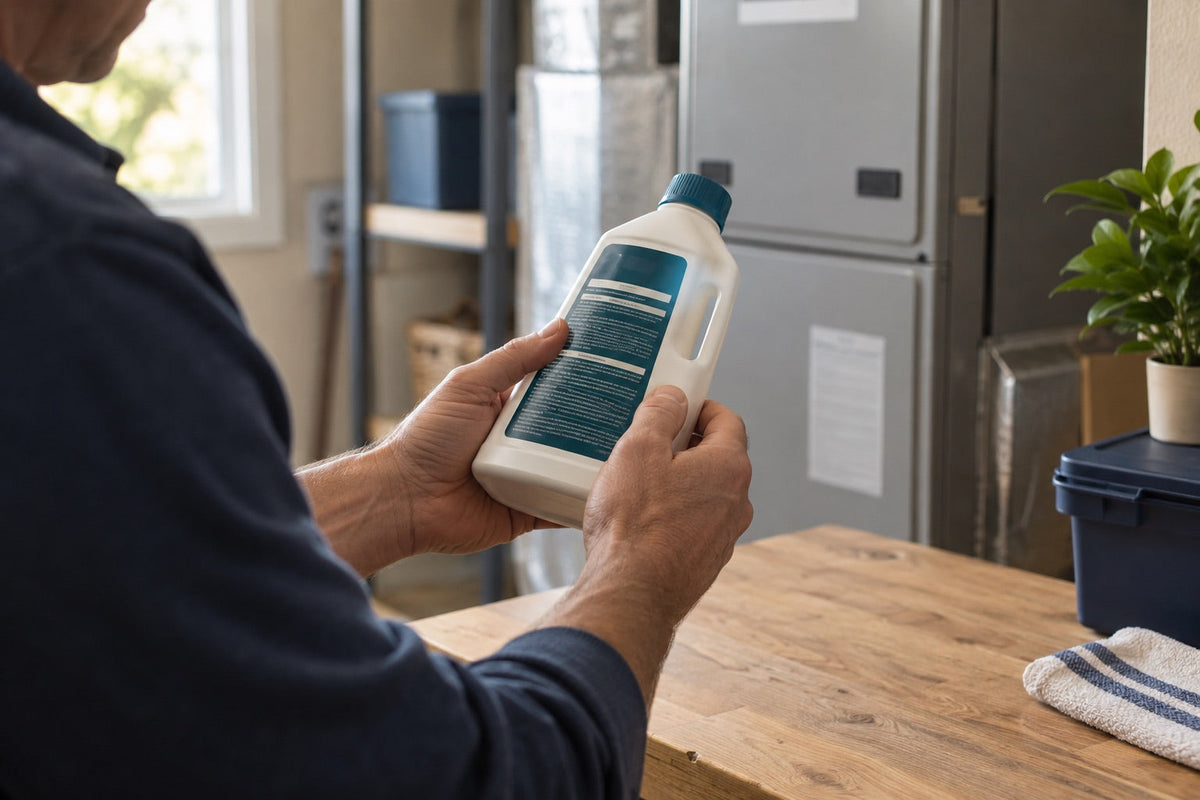
Hero image: AI-generated editorial illustration of label checking. It does not depict a real service visit or a Drano product.
PHYSICAL SUCTION · SCHEDULED MAINTENANCE
Unclog maintains your drain without recurring chemical dosing
Unclog automates suction cleaning at a compatible outdoor condensate-drain termination. Daily, weekly or monthly cycles help move developing buildup toward the outlet, giving an open drain a repeatable maintenance routine without repeatedly adding liquid cleaners or tablets.
This is the maintenance step after the current restriction and any chemical residue have been professionally addressed, normal flow is confirmed and compatibility is checked. Unclog is not a chemical-recovery tool or a repair for a failed pump, leaking pan or incorrect piping.
Why “safe for plastic pipes” is not A/C-system approval
Drano’s manufacturer FAQ says its products can be used with plastic or metal pipes when label directions are followed. That is different from confirming the product for an HVAC condensate assembly. The Commercial Max Gel page, for example, describes kitchen and bathroom drain use. We did not find A/C-specific approval in those reviewed instructions.
That distinction matters because the visible PVC is only one part of the installation. A service opening may connect to a pan, trap, pump or shared route. Pipe appearance alone cannot tell you which materials a liquid will contact, where it will collect behind a restriction, or how it can be removed safely.
| Check | What it establishes | What it does not establish |
|---|---|---|
| Exact cleaner label | Intended applications, directions and precautions for that formula | Approval for every appliance connected to a plastic pipe |
| A/C equipment instructions | Permitted cleaning methods for the installed equipment | That an unknown bottle is an equivalent treatment |
| Confirmed drain route | Which unit, pan, pump and outlet are connected | That an active blockage has been cleared |
We are not claiming that a single use inevitably destroys PVC or that every Drano formula is identical. The practical rule is to use a method supported for the specific product, equipment and installation. Without that confirmation, keep household drain opener out of the condensate system.
Already poured Drano into the A/C drain line?
The next person working on the drain needs to know what is in it. An ordinary shop-vac or flush tutorial assumes conditions that may no longer apply once a chemical cleaner has been added.
- Stop adding products. Do not add vinegar, bleach, another drain opener or a homemade neutralizer. Follow the exact bottle’s precautions. Drano’s Max Gel instructions warn against mixing with other cleaners and against plunging because retained product can splash.
- Keep people and pets away from the affected opening and liquid. Do not lean over the drain, open the piping or try to collect unknown residue yourself. For an exposure or spill, follow the product’s emergency instructions and obtain appropriate urgent help.
- Pause DIY suction, pressure and flushing. Do not connect Unclog or a wet/dry vacuum to recover the cleaner. Contact an HVAC professional and tell them about the chemical before they arrive; ask the cleaner manufacturer for product-specific guidance.
- Document what was added. Keep the original container or photograph its label. Record the amount, time, entry point, other products used and whether water is backed up. Tell the technician about any pump or shared drain.
What should you do instead of pouring in drain opener?
If no chemical cleaner has been added: identify the drain and decide whether the problem is a restriction or an equipment fault. A pan full of water, a pump that will not discharge, and an incorrectly routed pipe need different responses. Avoid treating every water problem as a clog that needs a stronger bottle.
Carrier’s drain-cleaning guidance describes professional inspection, physical removal such as outlet suction, a clean-water flow test, and reassembly. The key outcome is verified drainage, not merely liquid disappearing into an opening. Ask the technician to confirm that the identified route drains without backup or leakage and that disturbed parts and safety devices are restored.
For a known, accessible gravity drain with no chemical concern, use our A/C drain-line cleaning guide for method boundaries. For pump, shared-route, access or recurring-clog problems, arrange diagnosis. If cleaner is already present, use the checklist above rather than moving directly into those cleaning steps.
Is vinegar, bleach or an A/C pan tablet automatically a substitute?
No. An HVAC-labeled maintenance treatment and a household blockage remover are different products. Follow the treatment label and equipment instructions, including permitted location and concentration. Do not combine them or add a maintenance treatment on top of an unknown chemical. Our vinegar-versus-bleach guide covers that separate comparison.
Build an A/C drain routine that does not depend on another bottle
Once normal flow is restored, record the cause of the problem and the correct outdoor outlet. If a trap, pump, pan or pipe defect was involved, get that corrected before selecting prevention equipment.
For a compatible drain, Unclog makes physical suction a scheduled task instead of another reminder to pour a treatment. Choose daily, weekly or monthly programming as appropriate for your system and continue the inspections your HVAC professional recommends. Scheduled cleaning helps address developing buildup; it does not guarantee that every future blockage or water problem is prevented.
Drain clear? Check whether Unclog fits your home.
Review the outlet requirements, installation instructions and suction-cleaning features before choosing your maintenance setup.
Drano and A/C drain-line questions
Can I use a small amount of Drano in my A/C drain?
A smaller amount does not establish an approved HVAC use. Check the exact label and equipment instructions. Do not invent an A/C dose from directions intended for a sink or bathtub.
Can I vacuum the line after adding Drano?
Do not move straight to a household wet/dry vacuum or Unclog. Tell an HVAC professional which product was added and get product-specific guidance before any removal or cleaning attempt.
Will Unclog remove Drano left in the line?
Unclog is for scheduled suction maintenance on a compatible drain. Do not use it to recover household drain cleaner. Have the chemical and active blockage addressed before installation.
Does this mean all A/C drain treatments are unsuitable?
No. A treatment specifically labeled for HVAC maintenance may be appropriate when the equipment manufacturer allows it and its directions are followed. That does not make a household plumbing drain opener interchangeable with it.
Sources and editorial scope
Reviewed September 15, 2026 by Unclog editorial. This is an application and maintenance guide, not a chemical-remediation procedure or a test of Drano products. Unclog sells the suction-maintenance device discussed here and is not affiliated with Drano.
- Drano manufacturer FAQ: pipe claims are conditional on label directions.
- Commercial Drano Max Gel: stated applications and product-specific precautions.
- Carrier: How to Clean an AC Drain Line: professional clearing and verification.
For the broader method comparison, see A/C drain-line cleaning methods. Return to the Learning Center.