
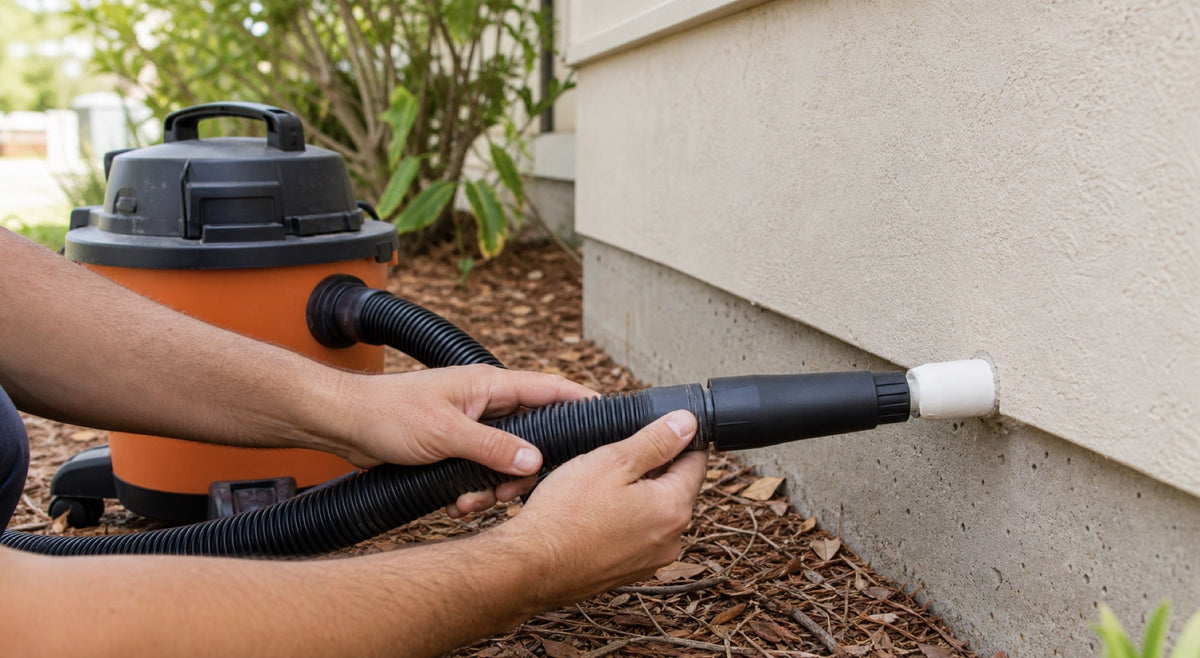
Short answer: A homeowner can often clean an accessible A/C condensate drain by turning the system off, confirming which pipe is actually the condensate drain, applying suction at the outdoor termination with a wet/dry vacuum, and then testing the line with clean water from the correct indoor access point. The job should end with proof that water travels through the entire line—not simply with debris appearing in the vacuum.
That short version leaves out the part that prevents mistakes: not every white pipe is a cleanout, not every wet pan means the pipe is clogged, and a maintenance flush is not the same thing as clearing a blocked line. This guide separates those situations so you can choose a sensible next step.
If water is touching electrical equipment, spreading through a ceiling, or coming from a drain you cannot confidently identify, turn the cooling system off and call a qualified A/C professional. For help diagnosing the problem first, read our guide to the signs and causes of a clogged A/C drain line.
Before you clean anything, identify the complete drain path
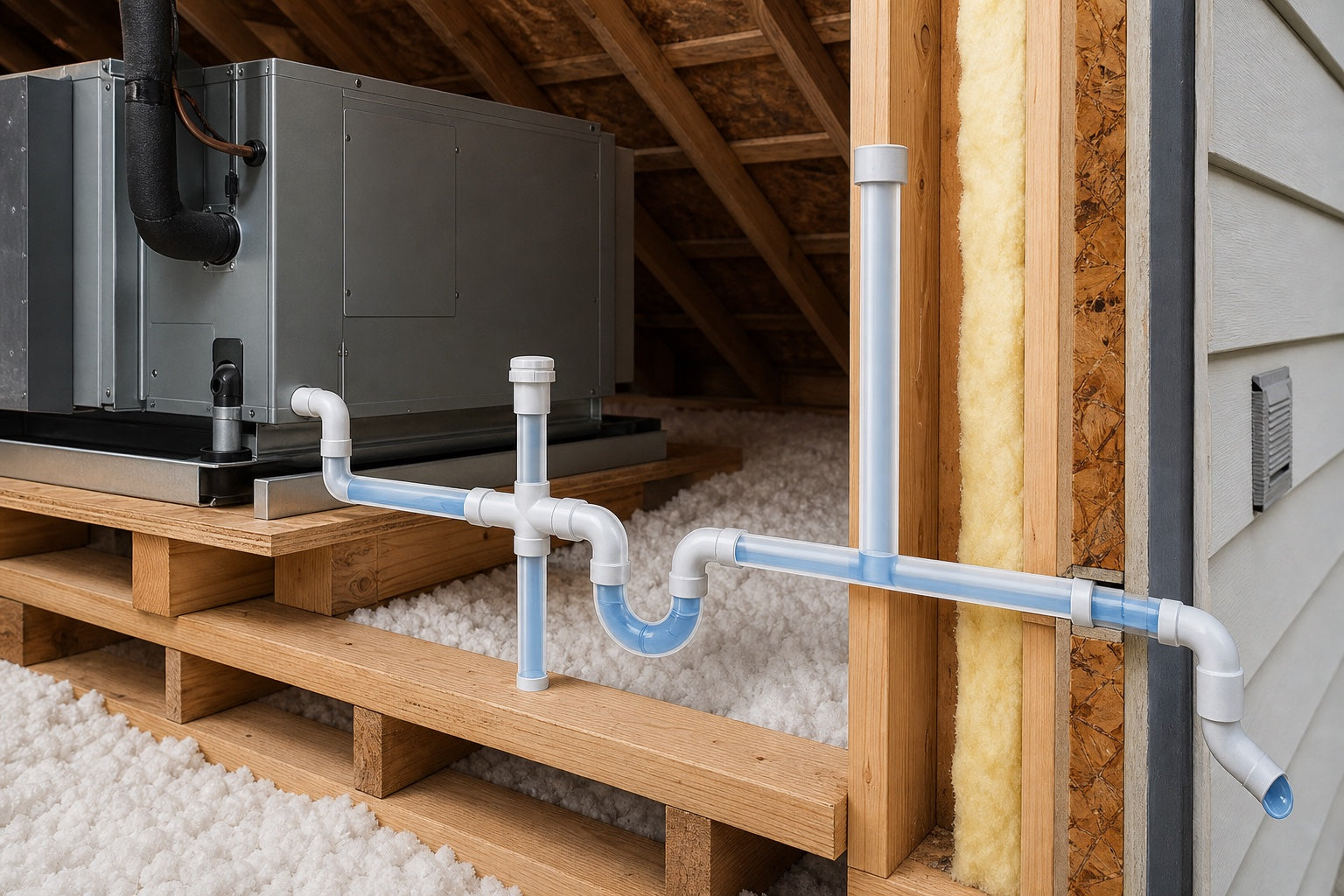
The condensate drain begins at the indoor evaporator coil. Moisture collected from the air falls into a drain pan, enters a drain connection, and moves through piping toward an approved discharge point. Depending on the installation, the route can include a trap, vent, cleanout, float switch, condensate pump, secondary drain, or more than one outdoor termination.
Find both ends before opening or pouring into anything:
- Indoor starting point: locate the air handler or furnace/coil cabinet and the PVC drain connection leaving the pan area.
- Service access: identify a cleanout or access opening intended for maintenance. A vent or float-switch chamber may look similar but serve a different purpose.
- Outdoor termination: trace or confirm where that same drain exits. Do not assume the nearest PVC stub belongs to the A/C.
- Safety components: note any auxiliary pan, float switch, wet switch, pump, or secondary drain.
Homes can have multiple air handlers, water-heater drains, pool equipment, irrigation pipes, or other PVC near the same wall. If you cannot trace the route with confidence, stop. Guessing at the opening is more likely to create a spill than to solve one.
Turn the system off before starting
Set the thermostat to off. If you will work near the indoor equipment, follow the equipment manufacturer’s shutdown instructions and disconnect power as directed. The goal is to stop new condensate production and avoid working around energized equipment or moving parts.
Know when this is no longer a routine DIY job
Skip the cleaning attempt and call a professional if you see wet wiring, a soaked equipment cabinet, ceiling damage, an inaccessible attic unit, cracked or disconnected piping, a pump that is not operating, a frozen coil, or water that returns immediately after the line appears clear.
Choose the method based on the problem
“Cleaning the drain line” can describe two different jobs. Treating them as interchangeable is why many quick fixes fail.
For an active restriction: remove material first
If water is backed up, the float switch has tripped, or the outdoor outlet is dry while the system has been producing condensate, the immediate goal is to restore flow. Suction from the outdoor termination is a common approach because it pulls material toward the end of the line instead of pushing it deeper into an unfamiliar route.
Pouring more liquid into a fully blocked pipe can simply add water upstream. A chemical may affect some biological residue, but it cannot reliably pull out leaves, construction debris, insects, pipe scale, or a dense plug of mixed sludge.
For a flowing line: inspect and maintain
If the line already drains normally, a maintenance visit is about confirming flow, cleaning accessible residue, and following the equipment manufacturer’s recommendation for the drain. That may include a water flush or a manufacturer-approved cleaning product. It does not require treating the pipe as an emergency clog.
How to clean an A/C drain line with a wet/dry vacuum
This method is appropriate only when you have positively identified an accessible outdoor condensate outlet and can work there safely. Use a vacuum designed for wet pickup—not a household dry vacuum.
What you will need
- A wet/dry vacuum set up for wet pickup according to its manual
- A tapered rubber adapter or other removable fitting that matches the vacuum hose and drain outlet
- Clean towels and a small bucket
- A flashlight
- Gloves and eye protection
- Clean water for the final flow test
A tight, temporary connection matters. Large air leaks around the hose reduce suction at the clog. Avoid permanent glue, excessive tape, or any adapter that can break the PVC outlet.
Step 1: inspect the indoor pan and access point
With the system off, look for standing water around the indoor unit, in the primary pan, or in the auxiliary pan. Remove accessible standing water with a wet vacuum or towels if you can do so without opening wet electrical compartments.
Check the access opening for loose debris, but do not insert a hard object deep into the pipe. Note whether the system has a trap or vent whose cap or configuration must be restored afterward.
Step 2: prepare the wet/dry vacuum
Empty the vacuum tank and configure the filter or foam sleeve exactly as its manufacturer specifies for wet pickup. Keep the power connection dry and use a properly protected outlet. Position the vacuum where it cannot tip over or pull sideways on the drain pipe.
Step 3: make a removable seal at the outdoor outlet
Fit the hose adapter over or around the condensate outlet without forcing it. Support the PVC with one hand while attaching the adapter so the wall penetration or fitting does not carry the load. If you have not positively identified the termination, use the outdoor A/C drain-line guide before connecting a vacuum.
The connection should direct suction through the pipe while remaining easy to remove. If the outlet is cracked, loose, buried, or too short to connect without stress, stop and have it repaired.

Step 4: apply suction and watch what changes
If a suitable suction attempt does not restore drainage, use the failed shop-vac clearing guide to separate no material collected, returning backup and continued indoor leakage before choosing the next step.
Run the wet/dry vacuum in short intervals consistent with its instructions. Listen for a change in airflow and watch the tank for water or debris. A mixture of water and soft residue may appear, but the appearance of debris alone does not prove the entire line is open.
If nothing moves, recheck the seal and confirm the outlet belongs to the correct system. Do not escalate to uncontrolled compressed air or high water pressure. A separated fitting inside a wall or attic can cause more damage than the original clog.
Step 5: remove the vacuum and inspect the result
Disconnect the adapter without twisting the pipe. Check that the outlet remains secure and unobstructed. Then return indoors for a controlled flow test.
When and how to flush the drain line
A flush is useful after physical flow has been restored or as maintenance on a line that is already draining. It is not a substitute for diagnosing standing water, a failed pump, a damaged pan, or a completely blocked pipe.
Use the correct service opening and follow the air-handler, coil, pump, and drain-cleaner manufacturers’ instructions. Carrier and Trane both describe distilled vinegar as a possible homeowner maintenance step in some systems, while also advising professional service for persistent or uncertain clogs. Equipment and drain configurations differ, so the correct product and amount are not universal. Compare the risks and limits in our vinegar versus bleach guide for A/C drain lines.
Use clean water for the proof-of-flow test
Slowly add a modest, controlled amount of clean water at the identified service access while another person watches the outdoor termination. Stop immediately if water rises at the access point, enters a float-switch chamber, appears at a fitting, or fails to emerge where expected.
Successful drainage should be visible at the correct outlet without leakage along the route. Restore every cap, vent configuration, trap prime, switch, and panel exactly as required before returning the system to service.
Do not mix drain chemicals
Never combine vinegar, bleach, ammonia, peroxide, drain opener, tablets, or an unknown residue. Mixing cleaners can release dangerous gases or create corrosive reactions. Ordinary plumbing drain opener is not a sensible default for HVAC condensate equipment.
If you do not know what was previously placed in the line, use no additional chemical. Tell the technician what you know and let them choose the next step.
How to know the cleaning actually worked
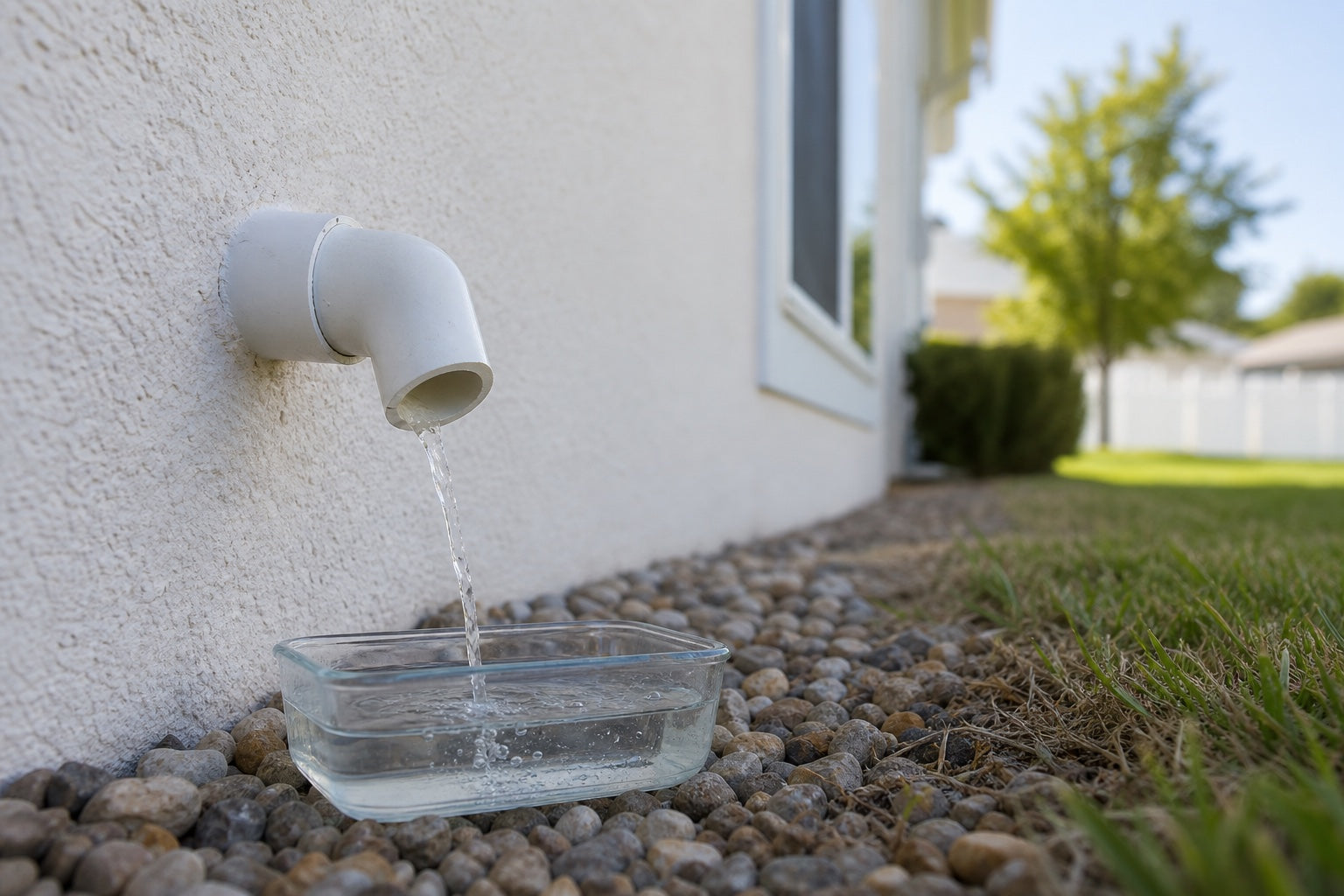
A clean-looking vacuum tank is not the final test. Confirm all of the following:
- Clean test water travels from the correct indoor access point to the intended discharge point.
- No fitting, pan, pump, or wall penetration leaks during the test.
- The primary and auxiliary pans do not refill unexpectedly.
- The float switch or wet switch remains installed and operational.
- All caps, traps, vents, access panels, and power settings are restored correctly.
- After restart, the system operates normally and condensate drains during a cooling cycle.
Some systems do not produce a visible outdoor drip at every moment. Condensate volume changes with humidity, runtime, equipment capacity, and drain routing. Compare the complete water path rather than using one dry pipe as the only diagnosis.
Common A/C drain-cleaning mistakes
Pouring into the wrong opening
A vent, float-switch chamber, secondary connection, or unrelated pipe can resemble a cleanout. Trace the system instead of relying on shape alone.
Bypassing the float switch
A tripped float is warning you that water is not leaving normally. Holding it down or removing it can trade a no-cooling problem for damaged ceilings, floors, or equipment.
Using uncontrolled pressure
Compressed gas, an unregulated hose, or a pressure tool can separate fittings or drive debris into a more difficult location. Professionals who use pressure understand the route, isolate components, and control the force.
Stopping as soon as sludge appears
A vacuum may remove material near the outlet while leaving a partial restriction upstream. Always test flow through the full route and investigate a clog that returns quickly.
Assuming every water problem is a clog
A frozen evaporator coil, cracked pan, loose fitting, failed condensate pump, poor pipe pitch, unprimed trap, or sweating ductwork can imitate a blocked drain. If the evidence conflicts, diagnose before repeating the same cleaning method.
How often should an A/C drain line be cleaned?
There is no honest single schedule for every home. A lightly used system in a dry climate and an attic unit running through a long, humid Florida summer do not produce the same amount of condensate or buildup.
At minimum, make drain inspection part of professional cooling-system maintenance. Check more often during heavy cooling months if the home has a history of clogs, long drain runs, high humidity, multiple systems, substantial airborne dust, or an attic installation where a leak could damage ceilings.
A practical routine is to look for standing water, verify safety switches, inspect the outlet, and confirm flow before peak cooling season—then repeat visual checks during the season. Let actual conditions and the equipment manufacturer’s instructions determine whether the line needs cleaning.
Preventing the next drain-line clog
Emergency cleaning is reactive. Prevention starts only after the line is confirmed open and the underlying installation is sound.
- Replace or clean the air filter on the schedule appropriate for the home and equipment.
- Keep the indoor cabinet and drain pan professionally maintained.
- Correct poor pitch, damaged fittings, unprotected outlets, or unreliable pumps.
- Keep the outdoor termination visible and accessible.
- Record which system belongs to each drain when a property has multiple A/C units.
- Use a repeatable maintenance method instead of waiting for a shutdown or ceiling stain.
Unclog is designed for compatible residential systems after normal drainage has been established. It connects at the outdoor termination and runs scheduled suction cycles to help move developing buildup before it becomes another complete restriction. It is a prevention tool—not a substitute for repairing a damaged installation or diagnosing an active water emergency.
When to call an A/C professional
Call a qualified professional when the line will not clear, the clog returns quickly, the outlet cannot be identified, water is near electrical parts, the evaporator coil is frozen, the condensate pump fails, or the drain route passes through inaccessible walls or ceilings.
Also call when the cleaning appears successful but the system still shuts off or water returns. That combination often means the original diagnosis was incomplete.
Frequently asked questions
Can I clean an A/C drain line myself?
Many homeowners can inspect and maintain a clearly identified, accessible condensate drain. Stop if the equipment is wet, the route is uncertain, the unit is difficult to access, or the first safe attempt does not restore verified flow.
Can I use a shop vac on an A/C drain line?
Use only a wet/dry vacuum configured for wet pickup. Apply suction at a positively identified outdoor termination with a removable, supported seal. Never use an ordinary household dry vacuum for water.
How long should I vacuum the condensate line?
There is no universal runtime because vacuum capacity, hose size, pipe length, and the restriction all vary. Use short intervals within the vacuum manufacturer’s operating instructions, then perform a controlled flow test. Longer vacuuming does not correct a bad seal or the wrong pipe.
Is vinegar or bleach better for an A/C drain line?
Neither is a universal answer. Manufacturer guidance, pipe material, coils, pumps, prior chemicals, and local disposal conditions matter. Never mix cleaners. Physical removal and proof of flow come before debating maintenance chemicals.
Can I pour boiling water into the condensate drain?
No. Boiling water can soften PVC, damage fittings, affect pumps, or create a burn hazard. Use only the temperature and cleaning method approved for the installed equipment.
Why is the drain still clogged after I used a vacuum?
The hose may not have sealed, the wrong outlet may have been selected, the blockage may be upstream of a trap, or the real problem may be a pump, pipe pitch, damaged fitting, or frozen coil. Repeated blind attempts increase risk; have the complete route inspected.
Should water always drip from the outside A/C drain?
Not continuously. Drainage changes with humidity and cooling runtime, and some systems discharge through a pump or plumbing connection. A dry outlet becomes meaningful when the system is producing condensate and water is backing up elsewhere.
What should I read next?
Learn the system from the beginning in The Complete Homeowner’s Guide to A/C Drain Lines, or use our clogged drain-line troubleshooting guide if you are still diagnosing symptoms.