
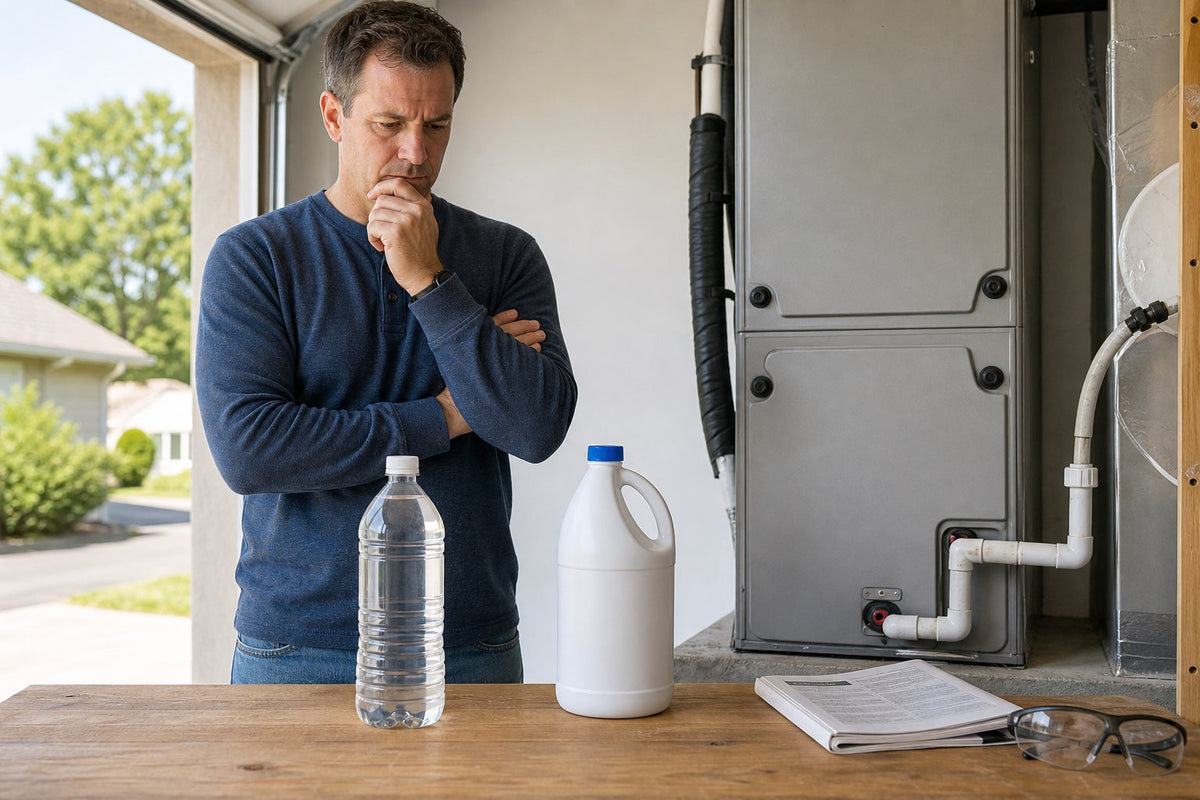
Short answer: Do not make monthly bleach, Clorox, or vinegar pouring your entire A/C drain-line maintenance plan. Some manufacturers recommend distilled vinegar for compatible equipment, but neither vinegar nor bleach proves a drain is clear. Bleach adds chemical-mixing and component-compatibility concerns. Follow your equipment instructions, verify drainage, and consider Unclog’s scheduled physical suction for an eligible system. Never mix cleaners or add treatment to an active backup.
The vinegar-versus-bleach question sounds simple because both products are familiar. The drain system is not. An A/C condensate path can include a primary pan, trap, vent, cleanout, float switch, pump, auxiliary drain, and concealed pipe. The material in the line may be soft biological buildup, dust, construction debris, mineral residue, or a physical obstruction.
That is why the safest choice starts with the condition of the system, not the bottle under the sink.
The short answer: treat the drain, not the internet argument
For a compatible line that is open and flowing, some equipment manufacturers and A/C professionals recommend distilled white vinegar as a maintenance step. Vinegar is a mild acid. It may help loosen or limit some residue, and it does not create the same chlorine exposure concerns as household bleach.
Bleach is a stronger oxidizer. It can react with other cleaners, release irritating fumes, and damage nearby materials if it backs up, splashes, or reaches a component that is not compatible with it. Advice about bleach also varies by equipment, drain-pan material, local practice, and the concentration being discussed.
Neither product repairs poor pipe pitch, a cracked pan, a failed condensate pump, or a float switch that keeps activating. Neither is a dependable way to clear a completely blocked pipe.
Should you pour bleach or vinegar into an A/C drain line every month?
A monthly reminder can be useful; an automatic monthly chemical dose is not a universal maintenance rule. The correct routine depends on the air handler, drain layout, any condensate pump, cooling-season conditions, and the instructions for those components. If your technician has specified a compatible vinegar routine, follow that plan. If the line keeps backing up despite it, investigate the cause instead of increasing the dose.
Trane’s drain guidance suggests having a technician demonstrate a distilled-vinegar treatment when recurring clogs are a problem. It also describes removing an obstruction, cleaning, and testing the drain. That is a broader maintenance process than simply pouring something every 30 days.
A calendar tells you when you last performed a task. It does not tell you whether water reached the outlet, whether the pump works, or whether sludge remains in a low section. Use a recurring reminder to inspect the drain and follow the approved maintenance plan, with extra attention to changes in drainage or a history of backups.
Monthly vinegar, monthly bleach, and scheduled suction compared
| Approach | What it can contribute | What it cannot establish |
|---|---|---|
| Approved distilled-vinegar routine | A technician-guided liquid maintenance step on compatible equipment. | That debris has been physically removed, a blockage is cleared, or every component is working. |
| Household bleach or Clorox | Bleach has disinfecting uses when the exact product is used as labeled. That does not establish an HVAC use. | Compatibility with the whole condensate system or a month of protection against clogs. |
| Unclog scheduled suction | Automated physical maintenance at a compatible outdoor drain termination, starting with a clear, intact line. | Repair of a pump, trap, damaged pan, poor pipe slope, or an active obstruction. |
Why a monthly pour can leave the underlying problem behind
- The material may not be something the liquid removes. Dust, construction debris, an insect obstruction, or a thick accumulation can still restrict the water path. Treating biological material and transporting an obstruction out of a pipe are different outcomes.
- There is no built-in flow check. Liquid disappearing into an opening does not show where it went. A partial blockage may pass some liquid while leaving a restriction behind.
- The installation may be the problem. A sag, incorrect slope, trap issue, or pump fault needs diagnosis. More frequent pouring does not correct those conditions.
- The routine still depends on a person. Someone must remember the task, identify the right access, use the specified product, and check the result. Logging a dose without checking the drain misses the most important evidence.
For a compatible system, Unclog’s scheduled suction addresses the repeat manual-task burden through a physical maintenance cycle. Keep inspecting the system and maintaining overflow protection; automation is not proof that every part of the drain is healthy.
First decide whether this is maintenance or a clog
This distinction changes the next step.
Routine maintenance means the system is draining normally, there is no abnormal standing water or backup in the primary pan, the auxiliary overflow pan is dry, and there is no active leak or shutdown. The goal is to inspect the water path and reduce the chance that developing residue becomes a restriction.
Clog response means water is backing up, the auxiliary pan is wet, a float switch has interrupted cooling, or test water will not reach the intended outlet. The goal is to remove the obstruction and restore verified flow.
Pouring a cup of any liquid into a fully blocked line can raise the water level near the air handler. If the line is already backed up, start with the clogged A/C drain-line guide or the complete drain-line cleaning guide.
What vinegar can and cannot do

Distilled white vinegar is widely discussed because it is inexpensive, easy to identify, and milder than many household chemicals. Carrier describes distilled vinegar as one possible homeowner maintenance step and notes that liquids may not prevent clogs caused by debris or other non-organic material. Trane suggests asking a technician to demonstrate the correct access and method for a system that repeatedly clogs.
Those qualifications matter. Vinegar can contact residue along the wet surface it reaches. It cannot pull a thick mass through the pipe, correct a sag that holds water, or remove material trapped beyond a complex fitting. It also cannot confirm that liquid reached the intended outlet without leaking somewhere along the route.
Do not assume stronger vinegar is better. Use ordinary distilled white vinegar only when that method is approved for the equipment. Do not substitute concentrated cleaning vinegar, flavored vinegar, or an unknown acid.
Why bleach deserves more caution
Household bleach can kill or oxidize some biological material, but that does not make it the right default for every condensate system. The solution may contact metal near the pan or coil, a pump, a rubber component, a glued fitting, or residue from a previous cleaner. A blocked pipe also gives the liquid nowhere safe to go.
The word diluted does not remove those questions. Concentrations differ, equipment materials differ, and homeowners may not know what is already inside the line. If the equipment manual or the servicing technician specifies a particular product and method, follow that guidance. Otherwise, avoid improvising with bleach.
Do not substitute a household plumbing drain opener for an equipment-approved HVAC treatment. See whether Drano belongs in an A/C drain line for the label limitations and what to do if cleaner has already been added.
Can Clorox damage an A/C condensate pump?
There is a specific manufacturer example: Little Giant’s VCMA pump FAQ warns that chlorine will damage that pump. It recommends a 50/50 water-and-vinegar mixture for cleaning the VCMA, annually or twice a year with substantial slime buildup. Those are instructions for that pump family, not a recipe or schedule for every A/C drain.
This is why “the pipe is PVC” is an incomplete compatibility check. The liquid may also enter a reservoir, pass a check valve, or contact other components. Check the instructions for the actual pump and equipment. It would be equally misleading to say all vinegar is unsafe for all pumps or that bleach automatically destroys every PVC drain.
Clorox is a brand, not one interchangeable drain treatment
Identify the exact bottle and its active ingredients, concentration, intended surfaces, and directions. A brand name or a familiar-looking container is not an equipment approval. Do not substitute scented, splashless, gel, concentrated, or other specialty formulations for a specified product.
The CDC’s household disinfection guidance distinguishes regular unscented bleach from some laundry and splashless formulations that are not appropriate for that disinfection method. This is surface-disinfection guidance, not permission to pour bleach into an HVAC system. Neither a kitchen-cleaning dilution nor a laundry dose should become an improvised condensate-drain recipe.
Disinfecting is not the same as clearing a drain
Disinfection depends on the product directions, dilution, and wet contact time. CDC also distinguishes removing dirt from killing remaining germs. A quick pour through a pipe does not demonstrate that the required surfaces stayed wet at the required concentration or that deposited material left the line. A household germ-killing claim is not evidence of month-long clog prevention.
Using more product or leaving it in longer is not a reliable solution. Clorox’s own safety guidance says overuse does not improve performance and can damage surfaces. It also cautions about runoff near storm drains, gardens, and wildlife. Know where your condensate discharges before introducing any treatment, and follow the applicable product and equipment directions.
Never mix cleaners
This is the non-negotiable rule. Never combine bleach with vinegar, ammonia, acids, peroxide, drain opener, toilet-bowl cleaner, or an unknown residue. Mixing bleach with an acid such as vinegar can release chlorine gas. Mixing bleach with ammonia can produce toxic chloramine gases. Clorox explicitly warns against both combinations.
Do not pour one product after another because the first one “did not work.” The trap and low sections of the line can retain liquid. If you do not know what was used previously, add no chemical. Tell the A/C technician what may be present before service begins.
Keep every container capped and in its original labeled packaging. Do not transfer a cleaning product into a beverage bottle or leave an unlabeled mixture near the equipment.
Find the correct access before adding anything

A vertical PVC opening near an air handler may be a service cleanout, vent, float-switch connection, trap primer point, or part of another drain. A cap is not permission to pour. Trace the line from the primary pan connection toward the discharge point and confirm the purpose of the opening.
Some traps require a specific water seal after service. Some vents need to remain open. Some access caps must be restored. A condensate pump introduces another reservoir and electrical component. If you cannot identify the route and the correct service opening, stop and have a qualified A/C professional show you.
The best time to learn the layout is during normal professional maintenance, not while water is spreading across a ceiling.
A safer maintenance decision process
- Check the equipment instructions. Look for condensate-drain maintenance guidance and product restrictions.
- Inspect before treating. Confirm the auxiliary overflow pan is dry, there is no primary-pan backup, the float switch is normal, and the outdoor termination is not buried or obstructed.
- Identify the complete path. Match the indoor service access to the correct discharge point and note any trap or pump.
- Do not add liquid to a backup. Restore flow first with a compatible physical cleaning method or professional service.
- Use only one approved product. Never mix cleaners or guess at a concentration.
- Verify the result. Confirm controlled test water reaches the intended outlet and does not leak along the route.
- Restore the system. Replace caps, preserve venting, prime the trap if required, and leave every safety switch operating.
A maintenance interval should also match the system. A long cooling season, attic equipment, repeat clog history, or high water-damage risk can justify more frequent visual checks. See how often to inspect and clean an A/C drain line for a practical schedule.
How to know the line is actually clear

The smell of vinegar disappearing is not proof of flow. Bubbles, noise, or a small amount of debris at the outlet are not proof either. A successful result is a complete water path.
Use controlled test water only through the identified access and only when the equipment instructions allow it. Watch the intended outlet. Check the pan, trap, pump, fittings, and visible pipe for leaks or backup. Restore every cap and safety device before the system returns to normal operation.
If water does not emerge where expected, or the pan begins to fill, stop. Repeating the same liquid treatment can hide a restriction without correcting it.
Where automatic suction fits
Vinegar and bleach are liquid-maintenance approaches. Suction is a physical method that moves material toward the outdoor termination. The two jobs should not be confused.
Unclog is designed for a compatible residential condensate drain that is already open, intact, and draining correctly. It runs scheduled suction cycles at the outdoor termination to help move developing buildup before it becomes another full restriction. It does not dose chemicals, repair damaged components, or replace professional A/C maintenance. Do not use suction equipment to handle unknown or hazardous chemical residue; tell the servicing technician what has been added first.
For homeowners who would rather avoid another chemical routine, see how Unclog works and review the installation requirements for the final production unit.
When to call an A/C professional
Call a qualified professional when water is near electrical equipment, entering a ceiling or wall, or collecting in an inaccessible attic area. Professional diagnosis is also appropriate when the line will not hold verified flow, the same clog returns quickly, a condensate pump fails, the route cannot be identified, or the equipment instructions conflict with generic online advice.
Carrier’s A/C drain-line guidance recommends professional help for persistent or uncertain clogs. Trane’s condensate-drain guidance likewise places vinegar within a broader maintenance and technician-guided process.
Frequently asked questions
Is pouring vinegar down the A/C drain every month enough?
It is not a complete maintenance program. A compatible vinegar routine may be part of your technician’s plan, but you still need to inspect for leaks and backups, maintain any pump and trap, and confirm drainage. Recurring clogs require diagnosis rather than a stronger or more frequent dose.
Can I alternate bleach and vinegar on different months?
Do not use the calendar as a chemical-safety check. A trap, reservoir, or blocked section may retain liquid. Never introduce bleach where vinegar or another incompatible or unknown cleaner may remain. Follow one equipment-approved plan and tell the technician what was used.
Does Unclog replace monthly bleach or vinegar pouring?
Unclog offers a physical maintenance approach using scheduled suction at a compatible outdoor termination, reducing reliance on recurring manual liquid treatments. Start with a clear, intact drain and follow installation requirements. It does not disinfect the air handler, repair drainage faults, or replace professional maintenance and inspection.
Is vinegar or bleach better for an A/C drain line?
Carrier and Trane describe distilled vinegar as a possible maintenance step. Vinegar does not carry bleach’s chlorine reaction risk when used on its own, but it must never be mixed with bleach. The correct method still depends on the equipment instructions, drain materials, access point, and whether the line is already flowing.
How much vinegar should I pour into an A/C drain line?
There is no universal amount for every system. Use only the amount and method approved by the equipment manufacturer or demonstrated by the servicing A/C professional. Confirm the correct access point and normal drainage first.
Will vinegar clear a completely clogged condensate drain?
Do not rely on it for a complete blockage. A backed-up pipe may hold the added liquid near the air handler. Physical removal with a compatible method, verified flow, or professional service is more appropriate.
Can I use bleach after vinegar if the vinegar did not work?
No. Never mix bleach with vinegar or add bleach where an acid or unknown cleaner may remain. The reaction can release dangerous gas. Stop adding chemicals and tell the technician what was used.
Can I use vinegar and baking soda together?
Do not improvise chemical combinations in an A/C condensate line. The foaming reaction does not prove that a physical obstruction has been removed, and the added material still has to travel through the trap and complete drain route.
What if I do not know what is already in the line?
Add no chemical. If the line needs service, tell the A/C professional that the existing residue is unknown so the system can be handled safely.
Researched and updated September 15, 2026. This article provides general homeowner education and does not replace the instructions for the installed equipment or an on-site diagnosis.